Showing posts with label MDG's. Show all posts

Sunday, 17 July 2011

POVERTY: UN millennium goal to halve poverty may have been achieved

Laurence Chandy, Geoffrey Gertz : YaleGlobal, 5 July 2011 With Little Notice, Globalization Reduced Poverty


A major success in a poverty-reduction goal for the new millennium – halving the proportion of people whose income is less than $1.25 per day – largely went unnoticed. The World Bank estimates poverty levels, but the most recent data is from 2005. By combining the recent country survey data of household consumption with latest figures on private consumption growth, Brookings Institution researchers Laurence Chandy and Geoffrey Gertz generated poverty estimates to the present day. They conclude that the world – even stubborn Sub-Saharan Africa – is in the midst of rapid poverty reduction; they credit economic growth and widespread development brought by globalization. Poverty reduction was one part of a key UN Millennium Goal, and global observers may sit up and take notice after two other key parts are achieved: full and productive employment for all and halving the proportion of people who suffer from hunger. In the meantime, the authors promise far-reaching consequences from rapid poverty reduction via growth. –
 Road to growth: Millions of Chinese have been lifted out of poverty, thanks to trade

It is customary to bemoan the intractability of global poverty and the lack of progress against the Millennium Development Goals. But the stunning fact is that, gone unnoticed, the goal to halve global poverty was probably reached three years ago.
We are in the midst of the fastest period of poverty reduction the world has ever seen. The global poverty rate, which stood at 25 percent in 2005, is ticking downwards at one to two percentage points a year, lifting around 70 million people – the population of Turkey or Thailand – out of destitution annually. Advances in human progress on such a scale are unprecedented, yet remain almost universally unacknowledged.
Official estimates of global poverty are compiled by the World Bank and stretch back 30 years. For most of that period, the trend has been one of slow, gradual reduction. By 2005, the year of the most recent official global poverty estimate, the number of people living under the international poverty line of $1.25 a day stood at 1.37 billion – an improvement of half a billion compared to the early 1980s, but a long way from the dream of a world free of poverty.

Today, it’s estimated that there are approximately 820 million people living on less than $1.25 a day.
Behind these aggregate figures lies a somber reality. In assessing the fortunes of the developing world during the late 20th century, countries can be roughly divided into two categories: China and the rest.China’s stunning economic reversal – 30 years ago, only 16 percent of its population lived above the poverty line, but by 2005, only 16 percent stood below it – masks others’ failings. Excluding China, the 500 million decrease in global poverty becomes an increase of 100 million. In the world’s poorest region, sub-Saharan Africa, the poverty rate remained above 50 percent throughout the period, which, given the region’s rapid population growth, translated into a near doubling in the number of its poor. Similarly in South Asia, Latin America and Europe–Central Asia there were more poor people in 2005 than there were a quarter of a century earlier.

 The number of the world's poor is falling rapidly.

This depressing track record shapes perspectives on poverty that abound today. Global poverty has come to be seen as a constant, with the poor cut off from the prosperity enjoyed elsewhere. Only a radical change to the current global order – an alternative system to globalization or a massive exercise in redistribution – could possibly alter this destiny.
In a new study of global poverty, we upend this narrative. By combining the most recent country survey data of household consumption with the latest figures on private consumption growth, we generated global poverty estimates from 2005 up to the present day. Poverty reduction accelerated in the early 2000s at a rate that has been sustained throughout the decade, even during the dark recesses of the financial crisis. Today, we estimate that there are approximately 820 million people living on less than $1.25 a day. This means that the prime target of the Millennium Development Goals – to halve the rate of global poverty by 2015 from its 1990 level – was probably achieved around three years ago. Whereas it took 25 years to reduce poverty by half a billion people up to 2005, the same feat was likely achieved in the six years between then and now. Never before have so many people been lifted out of poverty over such a brief period of time.
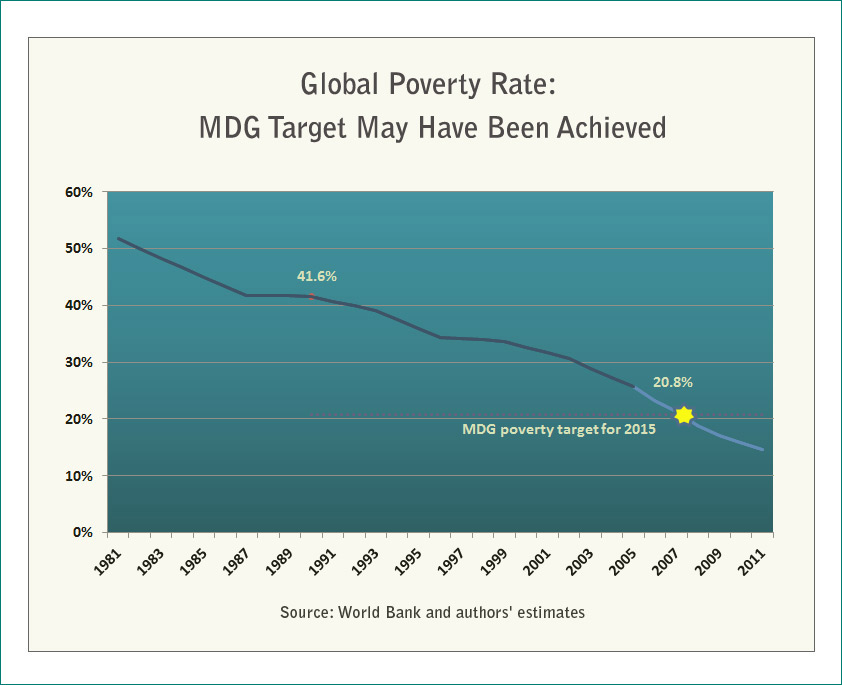
 The MDG poverty target may already have been achieved.
Not only is poverty falling rapidly, it’s falling across all regions and most countries. Unsurprisingly, the greatest reduction has occurred in Asia. But it’s not just the dynamic economies of East Asia, such as China, recording great feats in poverty reduction; South Asian giants including India and Bangladesh, and Central Asian economies such as Uzbekistan also make great strides. Even Sub-Saharan Africa is sharing in this progress. The region finally broke through the symbolic threshold of a 50 percent poverty rate in 2008 and its number of poor people has begun falling for the first time on record.
This stunning progress is driven by rapid economic growth across the developing world. During the 1980s and 1990s, per capita growth in developing countries averaged just 1 to 2 percent a year, not nearly fast enough to make a serious dent in poverty levels. Since around 2003, however, growth in the developing world has taken off, averaging 5 percent per capita a year.
How and why sustained high economic growth in developing countries took hold are questions likely to be debated by economic historians for many decades. Already one can point to a number of probable sources emerging or accelerating around the turn of the century: an investment boom triggered by rising commodity prices; high growth spillovers originating from large open emerging economies that utilize cross-border supply chains; diversification into novel export markets from cut flowers to call centers; spread of new technologies, in particular rapid adoption of cell phones; increased public and private investment in infrastructure; the cessation of a number of conflicts and improved political stability; and the abandonment of inferior growth strategies such as import substitution for a focus on macroeconomic health and improved competitiveness.

The poor countries that display the greatest success today are those that engage with the global economy.
These factors are manifestations of a set of broader trends – the rise of globalization, the spread of capitalism and the improving quality of economic governance – which together have enabled the developing world to begin converging on advanced economy incomes after centuries of divergence. The poor countries that display the greatest success today are those that are engaging with the global economy, allowing market prices to balance supply and demand and to allocate scarce resources, and pursuing sensible and strategic economic policies to spur investment, trade and job creation. It’s this potent combination that sets the current period apart from a history of insipid growth and intractable poverty.
The fight against poverty has long been a moral and strategic goal of Western governments. But the record of the last few years is likely a surprise to them. In their eyes, the fate of the world’s poor largely depended on forging progress on three fronts: debt relief, more aid and freer trade. World leaders convened at numerous meetings to build support and momentum around these priorities, but despite these efforts successes were hard to come by: While more than $80 billion of poor countries’ debt has been forgiven, most countries failed to meet global aid targets, and the Doha Development Round has languished at the World Trade Organization.
Thankfully for the world’s poor, this logic turned out to be flawed. While progress on each of the three fronts would have been helpful for developing countries and their ability to tackle poverty, the significance of each was undoubtedly overhyped and said more about the West’s sense of responsibility and magnanimity than what was actually needed to deliver development.
Taking a long view of history, the dramatic fall in poverty witnessed over the preceding six years represents a precursor to a new era. We’re on the cusp of an age of mass development, which will see the world transformed from being mostly poor to mostly middle class. The implications of such a change will be far-reaching, touching everything from global business opportunities to environmental and resource pressures to our institutions of global governance. Yet fundamentally it’s a story about billions of people around the world finally having the chance to build better lives for themselves and their children. We should consider ourselves fortunate to be alive at such a remarkable moment.

Laurence Chandy is a fellow at the Global Economy and Development Program in the Brookings Institution. Geoffrey Gertz is a research analyst in the same program. Their paper, “Poverty in Numbers: The Changing State of Global Poverty from 2005 to 2015” is available here.

http://yaleglobal.yale.edu/content/little-notice-globalization-reduced-poverty

Sunday, 10 July 2011

POVERTY: AID POLICY: 10 facts and figures from the 2011 MDG report

NAIROBI, 7 July 2011 (IRIN)

 Photo: Kenneth Odiwour/IRIN
One in 10 people may still be without access to safe drinking water by 2015, according to the latest MDG report (file photo)

 The 2011 Millennium Development Goals Report was released on 7 July with a generally upbeat assessment accompanied by some caveats. Here are some statistics:

1. The poverty reduction goal can be met by 2015, with the number of people in developing countries living on less than US$1.25 a day expected to fall below 900 million (from 1.8 billion in 1990).

2. Sub-Saharan Africa has made the greatest strides in primary school enrolment, from 58 percent in 1999 to 76 percent in 2009; however, 32 million children are still out of school in the region, almost half the global total of 67 million.

3. The number of women in parliament is at a record high - 19.3 percent from 11.6 percent in 1995; Rwanda, Sweden, South Africa and Cuba topped the list. Belize, the Federated States of Micronesia, Nauru, Oman, Palau, Qatar, Saudi Arabia, Solomon Islands and Tuvalu have no female parliamentarians at all.

4. In all regions, a mother's education is key to determining whether her children will turn five, with a child's chances of survival rising markedly with a mother's secondary or higher education.

5. While the demand for family planning will likely increase, in line with rising numbers of women and men of reproductive age, funding for such programmes has actually declined over the past decade, to 2.6 percent of total aid for health in 2009.

6. The use of insecticide-treated mosquito nets has surged, particularly in Africa: between 2008 and 2010, 290 million nets were distributed in sub-Saharan Africa, covering 76 percent of the 765 million people at risk.

7. Water resources are no longer sustainable in Western Asia and Northern Africa, which have exceeded the 75 percent limit on sustainable use. Southern Asia and the Caucasus and Central Asia are at rates of 58 and 56 percent respectively, compared with 3 percent in sub-Saharan Africa.

8. Latin America and the Caribbean, Eastern and Southeastern Asia have met the target of halving the proportion of the population without sustainable access to potable water. Coverage in sub-Saharan Africa rose from 49 percent in 1990 to 60 percent in 2008.

9. By the end of 2010, global mobile phone coverage was 76 percent, with mobile penetration at about 68 percent in developing countries. However, internet penetration was as low as 3 percent in least developed countries, compared with 21 percent in developing countries and 72 percent in developed regions.

10. Donor aid is likely to increase, but at a much slower pace - 2 percent between 2011 and 2013, compared with an average 8 percent per year over the past three years. Aid to Africa is expected to rise by just 1 percent in real terms, against an average of 13 percent over the past three years.

http://www.irinnews.org/report.aspx?reportid=93171

Friday, 8 July 2011

MALNUTRITION: IRAQ: A bad place for children

BAGHDAD, 4 July 2011 (IRIN)

 Photo: IRIN : For Iraq to achieve the MDGs, over 400,000 undernourished Iraqi children would have to receive adequate food, while nearly 700,000 would have to be enrolled in schools (file photo)

Decades of war and international sanctions have turned Iraq into one of the worst places for children in the Middle East and North Africa, with around 3.5 million living in poverty, 1.5 million under the age of five undernourished and 100 infants dying every day, the UN Children's Fund (UNICEF) warns.
The government can and should do more for children, said Sikander Khan, the outgoing UNICEF representative in Iraq, in a 30 June interview with the UN Assistance Mission to Iraq.
“It is the responsibility of the government to support parents by investing in health and education and other basic needs for all children… Central government can also take a significant step by making additional investments in its most deprived children."
Iraq, he added, was unlikely to achieve most of the eight Millennium Development Goals (MDGs), six of which relate to children. “Unfortunately, despite all efforts, the attainment of most of these goals in Iraq by 2015 is distant,” Khan said.
To achieve the MDGs, over 400,000 undernourished Iraqi children would have to receive adequate food, while nearly 700,000 would have to be enrolled in schools. Child mortality would also have to be reduced by 100,000, while about three million others need decent sanitation.
“These are not just statistics, behind every figure there is a child suffering in silence,” Khan noted. “Achieving these goals is possible if Iraq manages to focus on the over four million most deprived children.”

Still exploited
Iraqi children are also being exploited for purposes of war, where they are recruited by armed groups to fight, spy and scout, transport military supplies and equipment, videotape attacks for propaganda purposes, and plant explosives, according to a report covering the period from January 2008 to December 2010, by UN Secretary-General Ban Ki-moon.
They are also used as suicide bombers because they arouse less suspicion and easily move through security checkpoints. The report notes that the precise number of children involved in all these activities is difficult to ascertain.
Children, it added, have also been used to lure security forces into ambushes. In August 2010, armed gunmen entered a house in Sadiyah, north of Baghdad, killed three, and sent two children, aged 10 and 12, to report the attack to the Iraqi security forces. When the Iraqi army and police arrived, explosives planted in the house killed eight soldiers and wounded four.
There are also reports that the (Shia) Mahdi Army has recruited and used children as soldiers since the beginning of the conflict. In 2008, some 376 children were killed and 1,594 wounded, while in 2009, 362 children were killed and 1,044 wounded. In 2010, at least 194 children were killed and 232 wounded in the conflict, primarily in Baghdad, Diyala and Ninewa governorates.
Another threat to children identified by the report is explosive remnants of war, which claim lives and cause injury long after combat operations. An estimated 2.66 million cluster bomblets and 20 million landmines remain on Iraqi soil, contaminating 1,700sqkm. Many date from previous conflicts, such as the Iran-Iraq war in the 1980s and the first Gulf War.


A displaced family stands near a tent in a camp erected in an orchard in Diyala province, about 90Km east of Baghdad

http://www.irinnews.org/report.aspx?reportID=93133

Tuesday, 5 July 2011

POVERTY: China makes headway in poverty alleviation in South West

 2011-06-30
BEIJING, (Xinhua) -- Wu Weiyong and his family recently moved into a new 240-square-meter home in the village of Tongjing, located in Bijie Prefecture in southwest China's Guizhou Province.
The family makes about 200,000 yuan (about 30,880 U.S. dollars) every year by growing and selling herbs.
"Previously, we lived in a tiny 30-square-meter cottage. It only took a hailstorm to peel the roof off," said Wu.
Wu's family is among the beneficiaries of a continuing poverty alleviation project that was first created by the Communist Party of China (CPC) and the country's central government in Bijie in 1988.
Over the past 23 years, the project has reduced the impoverished population in this area to 318,400 in 2011, a far cry from 1988's figure of 3.12 million. The prefecture's absolute poverty rate has dived from 65.4 percent in 1988 to 7.6 percent in 2011.
Bijie has been afflicted with poverty and environmental degradation for years, as local farmers have distressed the land there through desertification and deforestation. The United Nations previously listed the prefecture as an "uninhabitable region."
The village of Tongjing was hit particularly hard by desertification. Over 80 percent of its land is uninhabitable due to water loss and soil erosion, and it is frequently hit by landslides and other natural disasters.
In June 1988, Hu Jintao, then Secretary of the CPC Guizhou Committee, proposed setting up an experimental poverty-reduction zone in Bijie. Hu's proposal was designed to address the region's problems with poverty, environmental degradation and its rapidly exploding population.
In the 23 years since Hu's proposal, the area has made great strides in alleviating poverty and building a self-sufficient economy. Residents typically make money by planting herbs and fruit trees, which has also helped to reverse desertification in the region.
Ecologically fragile areas like Tongjing require a diverse set of solutions, according to Peng Zhucai, the village's Party secretary.
The CPC and the government have worked to improve roads leading to the village, allowing people and businesses to travel in and out of the area with greater efficiency. They have also brought agricultural experts to the region to help the local farmers improve their harvests, Peng said.
Over the past five years, the per capita net income of the village's 3,100 farmers has doubled. The village's 12 communities now have roads connecting them together.
The CPC has made remarkable achievements in alleviating poverty since the country began its process of reform and opening-up in 1978, said Zheng Wenkai, deputy director of the State Council Leading Group Office of Poverty Alleviation and Development.
China's impoverished population decreased to 26.88 million in 2010, according to Zheng. This is a marked improvement from the 250 million people living in poverty in 1978.
China has managed to feed nearly 200 million poverty-stricken people over the past 32 years, said Zheng, who added that China was the first developing country to meet the poverty-reduction target specified in the UN Millennium Development Goals, a set of eight international development goals created by the UN in September 2000.
In the next ten years, China's poverty-alleviation efforts will focus on expanding access to cultural, educational and medical resources, said Zheng.
http://news.xinhuanet.com/english2010/china/2011-06/30/c_13958620.htm

Tuesday, 28 June 2011

POVERTY: Ghana: Government must pay attention to agriculture to eradicate poverty – Kufuor

22 June 2011
Former President John Agyekum Kufuor Former President John Agyekum Kufuor

Former President John Agyekum Kufuor has reiterated the need for government to attach utmost importance to agriculture if the country was to achieve its first Millennium Development Goal of halving extreme hunger and poverty by 2015.
According to him, Agriculture is the bedrock of the country's economy and if the government does not commit to sustaining and formulating new policies for the sector, the country may fall back into poverty.
Former President Kufuor, who was speaking on Dwaso Nsem on Adom FM on Wednesday from the United States, was commenting on a World Bank report that about 30% of the population is wallowing in poverty.
In his analysis of what could possibly account for that situation, Mr. Kufuor explained that the country’s farmers are growing old while the younger generation is not taking up farming and unless they embrace agriculture actively, there will be problems for the country.
He also attributed the poverty rate to the increasing population, explaining that if the pace at which the population increases outweighs productivity, then there is bound to be an increase in the poverty rate.
He therefore suggested that government should pay particular attention to the agriculture sector, stressing the need for farmers to be encouraged with policies that will benefit them and urge them on to do more.
President Kufuor emphasized the need for government to help farmers access loans to produce on large scale basis and boost productivity.
He said during his tenure, his administration put in place some initiatives which included providing fertilizers and pesticides for free to farmers while giving them extensive education on new farming trends through Agricultural officers.
He said through those policies, cocoa production increased from 350,000 tonnes when the NPP took over in 2000 to 750,000 tonnes and now production is at almost a million tonnes.
The former President also talked about the Presidential Special Initiatives on Oil Palm (through which over 600,000 hectares of oil palm trees were planted), cassava and others whose initiation, he said, people scoffed at but went a long way to encourage production on a large scale.
He said since times are changing and innovations are coming up, government should also study the new ways of doing things and implement them in the country.
He called for a critically look at planned parenthood to help manage the rate at which the population is increasing.
The World Food Prize Foundation honoured former President Kufuor, and Luiz InĂ¡cio Lula da Silva, former president of Brazil, for creating and implementing government policies that alleviated hunger and poverty in their countries.
President Kufuor while commenting on the honour said he had not expected to receive that honour although he had taken steps to help eradicate poverty.
He said he put in place policies especially in the Agriculture sector which went a long way to help halve extreme poverty adding that now Ghana is considered as a leading light in achieving the Millennium Development Goal 1 by 2015.
http://news.myjoyonline.com/news/201106/67963.asp

Tuesday, 21 June 2011

POVERTY: Better midwifery could save millions of lives

DURBAN, 20 June 2011 (IRIN)

 Photo: MSF
The world is short of about 350,000 skilled midwives

 Up to 3.6 million maternal and child deaths could be avoided each year if midwifery services were upgraded, according to a new report released by the United Nations Population Fund (UNFPA) and partners at a conference in Durban, South Africa.
"Public health advisors and practitioners are not relying on the key health professional that can improve maternal mortality - the midwife," said Vincent Fauveau, Senior Maternal Health Advisor with UNFPA, who led the drafting of the report.
Of the nearly 1,000 women who die every day as a result of complications during pregnancy and childbirth, 99 percent live in developing countries, mainly in sub-Saharan Africa. A woman in Sweden has a roughly 1 in 11,000 chance of dying from pregnancy-related causes, while a woman in Niger faces a 1 in 16 chance during her lifetime.
The first State of the World's Midwifery report released on 20 June at the International Confederation of Midwives (ICM) 29th Congress, said most of these deaths, as well as many of the severe illnesses and disabilities caused by childbirth, could be prevented by a proficient, motivated and supported midwifery workforce.
The report focuses on the 58 countries with the highest rates of maternal, foetal and newborn mortality. These countries account for 91 percent of the global burden of maternal mortality, but have less than 17 percent of the world's skilled birth attendants.
The fifth Millennium Development Goal (MDG), which focuses on reducing maternal health, had seen the least progress, Fauveau told IRIN. Nearly half of all deliveries occur at home without a skilled birth attendant. To meet the MDG 5 target of 95 percent of all births being assisted by a skilled birth attendant, some countries will need to increase the number of midwives by six to 15 times.
"It is not unusual to find one midwife managing 200 women in one facility. We must prioritize investment in midwives to deliver life-saving care in the communities where mothers are needlessly lost," said Lennie Kamwendo, a midwife and Chairperson of the White Ribbon Alliance for Safe Motherhood in Malawi.
Ahead of the congress, more than 2,000 midwives marched in Durban in solidarity with midwives across the world to urgently call for more midwives to save mothers and their babies. The report highlights the uneven distribution of midwives, with rural areas losing out to urban areas, and the fact that not all midwives are adequately trained.
The International Confederation of Midwives (ICM), a global umbrella body and host of the Durban conference, has launched new standards and regulations for midwifery but Fauveau said these will only be successful if "countries revise their educational curriculum".
Many women also struggle to access midwifery services, especially in rural areas, because of the distance they must travel to reach health facilities or because they cannot afford the transport costs and fees.
"We must advocate for free health services for all pregnant women in all countries. Women often do not have the funds to pay to get into the health facility during childbirth or pregnancy, so they die at home," said ICM President Bridget Lynch. Fauveau added that "a complication with childbirth is one of the most common ways to bring a family to poverty."
The report calls for governments to recognize midwifery as a distinct profession, and to increase investment in the number of schools, trainers and tutors for midwives, with adequate budget allocations for midwifery services included in national health plans.
"Midwives do far more than deliver babies," said Bunmi Makinwa, Africa Regional director of UNFPA. "They are the first to identify and treat HIV, tuberculosis and malaria, and sexually transmitted diseases. They also provide counselling to expecting women, and family planning advice. Midwives play a critical role."
http://www.irinnews.org/report.aspx?reportID=93028

Thursday, 19 May 2011

POVERTY: Maternal Deaths Worldwide Drop by Third

16 September 2010

The number of women dying due to complications during pregnancy and childbirth has decreased by 34% from an estimated 546 000 in 1990 to 358 000 in 2008, according to a new report, Trends in maternal mortality, released by the World Health Organization (WHO), the United Nations Children's Fund (UNICEF), the United Nations Population Fund (UNFPA) and the World Bank.
The progress is notable, but the annual rate of decline is less than half of what is needed to achieve the Millennium Development Goal (MDG) target of reducing the maternal mortality ratio by 75% between 1990 and 2015. This will require an annual decline of 5.5%. The 34% decline since 1990 translates into an average annual decline of just 2.3%.
"The global reduction in maternal death rates is encouraging news," says Dr Margaret Chan, the Director-General of WHO. "Countries where women are facing a high risk of death during pregnancy or childbirth are taking measures that are proving effective; they are training more midwives, and strengthening hospitals and health centres to assist pregnant women. No woman should die due to inadequate access to family planning and to pregnancy and delivery care."

Pregnant women still die from four major causes: severe bleeding after childbirth, infections, hypertensive disorders, and unsafe abortion. Every day, about 1000 women died due to these complications in 2008. Out of the 1000, 570 lived in sub-Saharan Africa, 300 in South Asia and five in high-income countries. The risk of a woman in a developing country dying from a pregnancy-related cause during her lifetime is about 36 times higher compared to a woman living in a developed country.
"To achieve our global goal of improving maternal health and to save women's lives we need to do more to reach those who are most at risk," says Anthony Lake, Executive Director of UNICEF. "That means reaching women in rural areas and poorer households, women from ethnic minorities and indigenous groups, and women living with HIV and in conflict zones."
The new estimates show that it is possible to prevent many more women from dying. Countries need to invest in their health systems and in the quality of care.
"Every birth should be safe and every pregnancy wanted," says Thoraya Ahmed Obaid, the Executive Director of UNFPA. "The lack of maternal health care violates women's rights to life, health, equality, and non-discrimination. MDG5 can be achieved," she adds, "but we urgently need to address the shortage of health workers and step up funding for reproductive health services."
UN agencies, donors and other partners have increasingly coordinated their assistance to countries. WHO, UNICEF, UNFPA and the World Bank are focusing on the countries with the greatest burden and help governments to develop and align their national health plans in order to accelerate progress in maternal and newborn health.
"Maternal deaths are both caused by poverty and are a cause of it. The costs of childbirth can quickly exhaust a family’s income, bringing with it even more financial hardship," says Tamar Manuelyan Atinc, Vice President for Human Development at the World Bank. "Given the weak state of health systems in many countries, we must work closely with governments, aid donors and agencies, and other partners to strengthen these systems so that women gain significantly better access to quality family planning and other reproductive health services, skilled midwives at their births, emergency obstetric care, and postnatal care for mothers and newborns."
The report that covers the period from 1990 to 2008 also highlights the following.
Ten out of 87 countries with maternal mortality ratios equal to or over 100 in 1990, are on track with an annual decline of 5.5% between 1990 and 2008. At the other extreme, 30 made insufficient or no progress since 1990
The study shows progress in sub-Saharan Africa where maternal mortality decreased by 26%.
In Asia, the number of maternal deaths is estimated to have dropped from 315 000 to 139 000 between 1990 and 2008, a 52% decrease.
99% of all maternal deaths in 2008 occurred in developing regions, with sub-Saharan Africa and South Asia accounting for 57% and 30% of all deaths respectively.
"We still need to do more to strengthen national data collection systems," says Dr Chan. "It is vital to support the development of complete and accurate civil registration systems that include births, deaths and causes of death. Every maternal death needs to be counted," she adds.
The UN maternal mortality estimates are developed in close collaboration with an international expert group and use all available country data on maternal mortality, as well as improved methods of estimation. The intensive country consultation carried out as part of the development of these estimates has been instrumental in identifying increased data collection efforts in recent years including the special systems to capture data on maternal deaths. There are however major gaps in the availability and quality of data for many countries where maternal mortality levels are high, and only through statistical modelling is it possible to obtain an understanding of the trend.
http://allafrica.com/stories/201009160176.html

Sunday, 15 May 2011

POVERTY: Sub-Sahara Africa: More Skilled Attendants Needed to Reduce Maternal Mortality

May 9, 2011 (IPS) -Miriam Gathigah
Motorcycle ambulance in South Sudan - distance to a healthcare facility and a shortage of trained personnel are key factors in maternal deaths. / Credit: Peter Martell/IRIN Credit: Peter Martell/IRIN
Motorcycle ambulance in South Sudan - distance to a healthcare facility and a shortage of trained personnel are key factors in maternal deaths.

Sub-Saharan African countries have claimed nine of the ten bottom places in a ranking of maternal health around the world. "The Mothers' Index", a new survey of motherhood by Save the Children, analyses health, education and economic conditions for women and children in 164 countries.
"Ironically, it is in giving birth - and multiple births for that matter - that a woman nears an approximate of the ideal of a wife," says Kolorinda James, a traditional birth attendant (TBA) in Juba, South Sudan. "Children are considered to be a sign of wealth. It is a case of the content being valued much more than the container - as thousands of women in this region continue to die from pregnancy related complications."

Contributing factors
Some 250,000 maternal deaths occur in Africa each year. There are several factors that make childbirth in Africa so dangerous. Millions of early marriages and teenage pregnancies mean riskier births to young women whose bodies have not developed to fully stand the rigors of childbirth.
Africa's health systems are inadequate to serve the needs of pregnant women, a majority of whom give birth without a skilled health worker present.
Across the continent, particularly in rural areas, a hospital or clinic with a trained midwife or doctor and facilities to deal with complications is often far away. The lack of good roads and transport – and the cost of transport - means a pregnant woman in trouble is unlikely to reach help in time.
Cost is also a factor for women and their families – even at highly subsidised public hospitals, the cost of giving birth can be beyond the reach of a woman living on a dollar or two a day. Many decide to give birth unaided at home, or with the help of an untrained attendant whose more modest fee can be paid in kind, with farm produce for example.
"Due to various factors such as poor infrastructure, most women deliver at home with no professional assistance and this leads to fatalities in many instances, because in case of a complication such as excessive bleeding, the woman will die," says Ousmane Hadari, a reproductive health consultant in Niger.
In Niger, cultural factors also lead many women to choose to give birth at home, regardless of the risk. "The trend has been that many women will attend the antenatal clinic - in fact, the percentages of pregnant women attending clinic has gone up in many countries - but most of them prefer to deliver at home for various cultural reasons."
Giving birth at home is seen as proof of a woman's fearlessness in the face of pain, says Hadari, adding that women also prefer to give birth at home so that they can carry out a custom to bury the placenta soon after birth.
James says cultural factors are also at work in South Sudan. "For many women the thought of being delivered by a male health attendant is taboo."

Birth attendants
But the shortage of skilled birth attendants is a key problem. James is one of roughly 2,000 TBAs registered by South Sudan's Ministry of Health who form the wafer-thin support for births in a population of 10 million. These TBAs have no formal qualifications, but James points out that TBAs have vast experience with deliveries acquired over years of practice. Traditional attendants enjoy the confidence of women in the community, and she says there are efforts to integrate TBAs into the health system as a means of drawing more women to hospitals for delivery.
"We are registered because we are not working in an ideal situation. There is a serious shortage of well-qualified nurses and midwives: what other options are there besides us?" says James.
Traditional birth attendants remain indispensable in a country where, according the Directorate of Nursing and Midwifery, there are barely more a thousand nurses - and only 40 who hold a diploma indicating basic knowledge of midwifery.
The World Health Organization (WHO) recommends that a skilled attendant be present at every birth, but in South Sudan there are only 10 nurses for every 100,000 births and just four adequately qualified registered nurses for every million children born.
South Sudan's Ministry of Health reports 2,037 maternal deaths for every 100,000 births. Hadari says Niger is not much better.
"The picture is not so different in Niger which has a staggering maternal mortality and morbidity rate particularly among the rural women and especially those with little or no education and consequently low or no income."
Niger ranked 163 in the Safe Motherhood Index, with 1,800 deaths per 100,000 births. One in seven Nigerien women will die from a pregnancy-related complication.

Models of success
Initiatives to improve maternal health are under way all over the continent, in an effort to meet Millennium Development Goal commitments to reduce maternal mortality by three-quarters from 1990 levels. Many countries seem unlikely to meet that target by 2015, but there are some positive models.
According to a 2010 World Health Organization report, maternal mortality in Ghana has fallen by a quarter in the last decade, to 560 per 100,000 births. Ghana has achieved this by revamping training, now adding 500 new midwives each year. The government has also made efforts to post health professionals to the areas with the worst maternal health statistics.
Mozambique is another success story. Mozambique's national health data shows maternal deaths fell from 1,000 deaths per 100,000 births in the 1990s, to 473 per 100,000 in 2007. This success has been built on the establishment of "waiting houses", which permit at-risk pregnant women to move to a temporary home near a local hospital in order to facilitate quick access to skilled health care once labor begins.
As 2015 draws nearer, these and other measures will need to be adopted and adapted across the continent if MDG targets are to be met.
Although Sudan is faring poorly, the country may be moving in the right direction with the continued development of maternal care at the Juba Teaching Hospital, where an initiative to train more nurses and midwives is based.
Janet Michael of the South Sudan Ministry of Health says the emphasis is being placed on the "need for trained birth attendants, high contraceptive prevalence, improved infrastructure to enhance access for women in need of various
institution based services and a budget that can sustain these initiatives."
http://ipsnews.net/news.asp?idnews=55539

Saturday, 7 May 2011

POVERTY: World Bank: 1.5 billion people live in countries affected by repeated cycles of violence and conflict

 April 13, 2011 : Leni Wild


The World Bank’s latest World Development Report (WDR) presents some sobering realities for the relationship between conflict and underdevelopment in the world today. It estimates that 1.5 billion people live in countries affected by repeated cycles of violence and conflict, and that no low-income fragile country has yet to achieve a single Millennium Development Goal. Changing patterns of conflict and violence now characterise the lives of many in the poorest countries; while deaths from civil war have fallen to one-quarter of what they were in the 1980s, one in four people still live in conflict affected countries with very high levels of criminal and political violence.
The WDR offers important new perspectives for how to make progress in supporting transitions out of fragility:
The WDR stresses the importance of ‘getting the basics rights’ – that citizens’ security, justice and access to jobs should be key priorities for achieving greater stability.
The Report underpins this with a recognition that institutional transformation sits at the heart of successful transitions out of fragility. It stresses the role of legitimate institutions in providing the ‘immune system’ against external and internal shocks, something emphasised by recent reviews of the impact of the financial crisis. Helpfully, notions of legitimacy are linked to concepts of social cohesion and social capital, rather than narrow normative commitments to Western democratic models, and the report takes care to emphasise ‘best fit’ over ‘best practice’ models for institutional change.
Linking to institutional transformations, it emphasises the need for much longer timeframes for engagement in fragile states, and draws on an impressive historical analysis of transitions out of fragility for a wide range of countries.
The Report turns the spotlight back on the international community. It highlights the importance of addressing external stresses, such as the infiltration of organised crime and trafficking networks or spill-overs from neighbouring conflicts. And it explicitly recognises tensions between the need for smarter, longer-term engagement to address fragility, and international actors’ sensitivities to domestic criticism on the grounds of waste, corruption or a lack of results. This is termed the ‘dual accountabilities’ between countries’ own taxpayers and partner countries, and it is rightly identified as a key factor behind the lack of progress in changing the approaches of international actors in fragile contexts. Madeleine Bunting recently commented on these tensions in the UK context too.
While these dimensions provide important contributions to this debate, I would have liked to see more thinking about the operational implications of some of this analysis. Two key issues seem to stand out.
Firstly, the WDR helpfully nuances its discussion on legitimacy with reference to moving away from blueprints and towards ‘best fit’, but it skirts around the state-society relations that underpin legitimacy. Instead, it falls back on some of the language of good governance and conventional supply versus demand approaches to accountability. This misses the current state of thinking on these issues, which emphasises moving beyond supply/demand dichotomies and the need to work much more effectively with a range of formal and informal institutions (with the latter often key providers of security and justice in many fragile states). This is challenging for donors (bilateral and multilateral) and greater guidance is needed for how to proceed.
Secondly, the report makes a useful attempt to bring in a wider audience – diplomatic and security actors as well as emerging donors and the private sector all get a mention – but it does not substantively engage with what it would take to ensure greater coherence and cooperation within and across the international community. Reviews of Whole-of-Government approaches, for instance, highlight that greater cooperation requires significant political will and strong mechanisms for mediating between competing priorities. Lessons may be learnt from this for attempts to build deeper cooperation but the WDR is generally silent on how this might be substantively realised.
What the WDR makes clear is that this is not business as usual and that new approaches are needed to effectively engage with fragile states. While this is not new to a number of bilateral donors (including the UK, which is scaling up its commitments to these countries), it is interesting that the World Bank has gone so far in analysing some of the political dynamics, tensions and challenges that sit at the heart of addressing conflict and fragility.
The Report is effectively calling for major shifts in the type of things that are funded in fragile states, with a lot more emphasis on effective, legitimate police forces and justice systems. In many ways this goes well beyond the current mandate of the World Bank, and these are not areas where it has a strong track record. But the Report is clear that multilaterals should engage more in some areas that have traditionally been outside their span of action. While I applaud this shift towards taking politics more seriously, we should not underestimate the challenges it will pose for operational staff, both within the World Bank and beyond.
http://blogs.odi.org.uk/blogs/main/archive/2011/04/13/57800.aspx?utm_source=newsletter&utm_medium=email&utm_campaign=20110503

Tuesday, 3 May 2011

MALNUTRITION: DRC: European Union grants 9.9m euros aid

Brussels, Belgium - The European Union (EU) has decided to release an emergency humanitarian aid of 9.9 million euros to cater for children suffering from malnutrition in the Democratic Republic of Congo (DRC), an official source told PANA here. According to a communique issued Wednesday by the European Commission services in Brussels, the funds will serve in providing assistance to the Congolese children under five, suffering from severe malnutrition. 'These funds will serve for financing projects aimed at delivering to those children the treatment required for their survival, whether it be food rations or medical care,' the communique indicated. The European Union said humanitarian aid meant for children completes the longer-term development aid and helps the country to reach the Millennium Development Goals (MDGs), aimed at reducing hunger, poverty, as well as child and maternal mortality.
Official reports indicated that out of 1,000 babies born in DRC, 158 die before five.
According to the reports, despite some progress achieved these last years in the fight against malnutrition in the country, the malnutrition rate remains higher than two per cent in the western provinces of the country.
http://www.afriquejet.com/news/africa-news/european-union-grants-9.9m-euros-aid-to-drc-2011042810230.html

Sunday, 1 May 2011

POVERTY: Stillbirths could be halved

DAKAR, 27 April 2011 (IRIN)

 Photo: MSF
A midwife listens to the foetal heartbeat of an expectant mother in Afghanistan (file photo)

 Preventing stillbirths can cost just US$2.32 per mother if governments, the private sector and international institutions adopt a package of 10 health interventions, rather than allowing stillbirths to be an almost invisible problem.
If ten recommended interventions were 99 percent implemented in 68 priority [low and middle-income] countries, the number of stillbirths could be halved, said Professor Zulfiqar Ahmed Bhutta of the Aga Khan University Medical Centre in Karachi, Pakistan, author of one of a series of papers on stillbirth published in The Lancet medical journal papers.
Even if the interventions were 60% covered, stillbirths could be reduced by one-quarter. Some 2.64 million foetuses die after the 28th week of pregnancy, mostly in low- and middle-income countries.
Interventions include: basic and comprehensive emergency obstetric care; skilled care at birth; detection and management of foetal growth restriction; detection and management of hypertension in pregnancy; elective induction in post-term pregnancies; insecticide-treated bed nets and intermittent prophylaxis to prevent malaria; detection and treatment of syphilis; folic acid supplementation; and management of diabetes in pregnancy.

Identifying solutions
Stillbirths have largely been neglected in policy prioritizing for a variety of reasons. “There was little in terms of verified data for stillbirths and even less for its categories - whether intrapartum [during childbirth] or antepartum [before childbirth] - and risk factors, and little confidence that interventions could make a difference,” said Bhutta.
The Lancet series hopes to change this perception by re-framing stillbirths so that they are not seen as an unexplained event that occurs in the womb, but as something that is potentially preventable if appropriate care is given during pregnancy and birth.
Bhutta suggested in his paper that cheaper solutions, such as improving antenatal care, preventing malaria, detecting and treating syphilis, be adopted immediately, while more expensive interventions, such as training health workers, and procuring equipment for emergency births, could be built up gradually.
Other interventions would require improved long-term funding allocations, including addressing hypertension, diabetes, post-term pregnancy (which lasts longer than usual) and monitoring foetal growth problems.
Providing skilled attendants at birth would reduce intrapartum stillbirths by about 23 percent, said Dr Joy Lawn, of NGO Save the Children, making it the most effective single intervention. Almost half the women in low- and middle-income countries give birth at home, without any skilled assistance.
Voucher schemes or conditional cash transfers could be used to encourage women to have their babies in a facility, since in settings where the highest infant mortality occurs, only half of all births take place in facilities.

Maternal mortality
In high-income countries, where most women receive fairly good quality care while giving birth, the proportion of stillbirths is less than 10 percent of all births.
Sub-Saharan Africa, which has a scarcity of skilled birth attendants, has been making swifter progress than Asia in encouraging women to give birth in a facility. “One year ago, the international community became acutely nervous about the lack of progress on reducing maternal mortality,” Lawn said.
A year later, maternal mortality in sub-Saharan Africa had fallen by 2.6 percent. “This marks significant progress… For stillbirths, a lot of the focus in high-income countries has been because parents have called for it. Setting a global policy goal is one good way of getting it on the agenda.”
One-third of African countries could meet the Millennium Development Goal to reduce childhood mortality (Goal Four) and to improve maternal health (Goal Five), which would also reduce stillbirths.
Some investments in reducing maternal mortality are already having a positive effect on the number of stillbirths, but these results are not given due significance. “Governments could argue for more investment if they counted stillbirths in the work they’re already doing,” Lawn told IRIN.
Saving mothers’ lives costs $23,000 per death averted, but if stillbirths and neonatal deaths are included, the figure drops to $2,700 per life saved. “Our single message is, ‘Care at birth may be more expensive, but it gives you the biggest bang for your same buck if you count it properly’
http://www.irinnews.org/report.aspx?reportid=92590

MALARIA: Ethiopia: Supporting rural health workers to combat malaria

22 December 2010 Extending the fight against malaria in Ethiopia
Supporting rural health workers to combat malaria


Almaz is 24 years old and has been working as a Health Extension Worker (HEW) for the last three years, in her own village which is more than an hour's drive from the nearest small town.
"The work is very hard, I have to work long hours and walk long distances but I am proud to be serving my community and have seen real changes in their health," she says.
A health worker in Ethiopia treating a woman and her baby A health worker in Ethiopia treats a woman and her baby


Almaz is one of more than 34,000 HEWs who have been trained and deployed to deliver a 'package' of basic services to their communities, including the prevention, diagnosis and treatment of malaria, family planning and immunisation.
Ten years ago, only two-thirds of Ethiopians had access to health services. Rural areas, in particular, suffered from a lack of medical facilities and health workers. There was a critical need to bring healthcare to more of Ethiopia's people. And over the last five years, the Health Extension Programme, the flagship programme of the Ethiopian ministry of health, has aimed to do just that.
At the centre of the HEP are female health workers like Almaz who operate within local communities. In each rural "kebele" (a community of about 5,000 people), two women who have completed tenth grade are selected to become Health Extension Workers.
This national programme has helped to deliver real improvements in people's health including reducing the previously devastating impact of malaria. The HEWs teach their communities about how to prevent malaria and to seek help when they have a fever.
They have also been trained and equipped to test people for malaria at the community level, which ensures correct diagnosis and treatment. Additionally, in the last five years more than 35 million insecticide-treated nets have been distributed across the country, which are reducing the numbers of people becoming infected.

Getting healthcare to communities
The UK is supporting the Health Extension Programme through a contribution to the government of Ethiopia district level 'block grant', which pays for the delivery of services. This block grant is used by districts across the country to deliver priority services, including health and education, to its communities.
UK funding is currently supporting more than 3,900 Health Extension Workers to deliver health services to around nine million people. Additionally, the British Government provides direct support to the Ethiopian ministry of health to help it to deliver its ambitious plans to meet all of the health related MDG targets by 2015, including those on malaria.

Facts and stats
The latest World Health Organisation rapid impact assessment in four main regions in Ethiopia shows that between 2001-2004 (annual average) and 2007, confirmed malaria outpatient cases decreased by 67%, malaria admissions by 54%, and malaria deaths by 55%.
The government of Ethiopia's next five year plan includes efforts to further increase utilisation of ITNs and strengthen diagnosis and treatment of malaria.
http://www.dfid.gov.uk/Media-Room/Case-Studies/2010/Extending-the-fight-against-malaria-in-Ethiopia/

Monday, 25 April 2011

POVERTY: MDG poverty goals may be achieved, but child mortality is not improving

Claire Provost guardian.co.uk, 18 April 2011


IMF and World Bank advocate 'performance-related' pay for medics to improve maternal and child mortality, but the greatest threat to MDGs remains the 'cycles of violence' in fragile states

 Children in Delhi, next to a billboard for a comic book fair
Children in Delhi, next to a billboard for a comic book fair in February. Child mortality targets for the millennium development goals are unlikely to be met and, despite India's economic progress, there remain deep-rooted wealth disparities and enduring social exclusion. Photograph: Manish Swarup/AP

Two-thirds of developing countries are on track or close to meeting the millennium development goal (MDG) targets for extreme poverty and hunger, say the World Bank and the IMF.
According to the Global Monitoring Report, released on Friday in Washington during the Bretton Woods spring meetings, the number of people living in extreme poverty – on less than $1.25 per day – will drop to 883 million by 2015, from 1.4 billion in 2005 and 1.8 billion in 1990.
The joint IMF-World Bank report explores current successes and shortfalls on achieving the MDGs, attempting to project future progress while also offering policy prescriptions – with an emphasis on sustained economic growth.
Much of world's recent progress on the first goal – to halve between 1990 and 2015 the proportion of people in extreme poverty and those suffering from hunger – reflects rapid growth in China and India; the report projects that, by 2015, only 4.8% of China's population will be in extreme poverty compared with 36% in sub-Saharan Africa. While the world is set to halve extreme poverty by 2015, 17 African countries are still off-track.
Progress on reducing poverty at national levels often obscures deep-rooted disparities, says the analysis, adding that enduring issues of social exclusion could lead to uneven improvements that would put at risk aggregate success.
At a press conference on Thursday, Robert Zoellick, the World Bank president, warned that high and volatile food prices could prevent success on poverty and hunger targets. Forty-four million people have "fallen into poverty" since June 2010, said Zoellick.
"If the food price index rises by just another 10% … another 10 million people will fall into extreme poverty where people live on less than $1.25 a day. And a 30% increase would add 34 million more people to the world's poor."
Zoellick's proposed steps to reduce the impact, and likelihood, of future food crises include a new code of conduct on export bans, improved information on the quality and quantity of food stocks, and preparing small stocks of humanitarian food in places like the Horn of Africa.
"The World Bank and the regional development banks can help countries with quick support for the most vulnerable through effective, targeted nutrition and safety-net programmes rather than mistaken price controls or broad-based increases in wages," he added.
Many developing countries are close to meeting targets on primary education completion and eliminating the gender disparity in education, as well as access to safe drinking water. However, no low-income country has reduced mortality for under-fives sufficiently and they are unlikely to meet that MDG target.
Maternal and child mortality targets remain among the most intractable of the goals: 40% of developing countries are far from meeting health MDGs, despite unprecedented amounts of aid funnelled into the health sector in the past 10 years.
Delfin Go, the World Bank's lead economist and the report's lead author, said: "Certain health and education outcomes are disappointing, in part because spending has focused largely on increasing the quantity of services, while not paying enough attention to quality." Go suggests improving incentives for health workers by, for example, paying on the basis of their performance, as well as "strengthening institutions".
The report points to Rwanda's experience, where the government supplemented primary healthcare with a "cash for performance" programme – paying clinics on the basis of, for example, the number of children vaccinated, the number of women who start to use contraceptives, the number of mothers who give birth in the presence of skilled midwives, or the number of malnourished children referred for treatment.
But 45% of developing countries are far from meeting the notoriously neglected international targets on sanitation.
And lagging furthest behind on MDG targets are the so-called "fragile states". These countries "require additional support, to help in building institutions and moving towards a virtuous circle of development, peace, and security", says the report.
The World Bank also urges a stronger focus on development in fragile states in its 2011 development report (WDR), released on Monday last week, in advance of the meetings. But, warns the WDR, the greatest blocks to reaching international development goals are the chronic cycles of criminal and political violence.
http://www.guardian.co.uk/global-development/poverty-matters/2011/apr/18/millennium-development-goals-world-bank-imf-report

Saturday, 23 April 2011

POVERTY: Home-grown nutrition research for Africa

JOHANNESBURG, 21 April 2011 (IRIN)

 Photo: Manoocher Deghati/IRIN
A more suitable choice of nutrition intervention in the offing?

A group of international academic institutions and an NGO backed by the European Union (EU) have launched Sustainable Nutrition Research for Africa in the Years to come, or SUNRAY, to develop a nutrition agenda for Africa, with specific emphasis on the 34 sub-Saharan countries.
"We want to make sure nutrition interventions in the next 10-15 years - when Africa faces potential environmental changes which will impact on nutrition - are sustainable, driven by African countries, and their priorities are not pre-defined by donors," said Carl Lachat, a researcher at the Belgium-based Institute for Tropical Medicine, one of the participating institutions.
A recent study by the International Food Policy Research Institute (IFPRI), a US-based think-tank, found that in another two decades the effect of climate change on food production could drive child malnutrition up by 20 percent.
The two-year SUNRAY project has invited proposals for working papers from African researchers to review the relationship between nutrition and climate change; the influence of rising food prices; the future availability of water; social dynamics in households, and the effect of rapid urbanization, among other themes in order to identify the specific research needs for nutrition in these areas.

Research in Africa
Proposals for working papers will be assessed by academics at four universities in sub-Saharan Africa: North-West University in South Africa; Sokoine University in Tanzania; the University of Abomey-Calavi in Benin; and Makerere University in Uganda.
"South Africa plays in a different league in terms of research when compared to the rest of Africa, but our research is more influenced by Western concepts, so if you are to look at good home-grown research pertaining to local foodstuffs, Nigeria and Kenya are a lot more advanced," said Prof Annamarie Kruger, director of the Africa Unit for Transdisciplinary Health Research at North-West University.
We now have an opportunity to develop interventions suited for African conditions and we have a say in our agenda ... it is not like we are doing research for European driven projects
"This project is very attractive in the sense that we now have an opportunity to develop interventions suited for African conditions and we have a say in our agenda; we also know the gaps that need to be addressed - it is not like we are doing research for European driven projects."
Lachat pointed out that the backing of the EU meant rich countries are calling for African involvement in setting the priorities for nutrition research and funding.
Proposals for the project are being accepted by 22 April, with the first of a series of workshops with the authors being held later in 2011.
Ahead of the workshops, the collaborating institutions intend holding discussions with nutritionists, researchers, businesspeople in the food sector, and policy makers in seven African countries - Benin, Mozambique, Rwanda, South Africa, Uganda, Togo and Tanzania.
Lachat said they realized that political backing was critical to ensure the research made the journey from paper to the real world, so "we are involving African political leaders in the initiative."
The project will produce a roadmap document summarising research priorities, strengths and gaps, resource requirements, opportunities for linkage and support between African and Northern institutions, or synergies between existing initiatives and research in other sectors.
Only nine of the 46 countries in sub-Saharan Africa are on track to achieve the UN Millennium Development Goal to eradicate extreme poverty and hunger by 2015.
http://www.irinnews.org/report.aspx?reportID=92550

Sunday, 17 April 2011

POVERTY: More developing countries closer to achieving Millennium Development Goals: World Bank


 2011-04-16
WASHINGTON, April 15 (Xinhua) -- Two-thirds of developing countries are on track or close to meeting key targets for tackling extreme poverty and hunger, but more work remains to be done, the World Bank and International Monetary Fund said Friday.
Among developing countries that are falling short on the Millennium Development Goals, half are close to becoming on-track. With improved policies and faster growth, these countries can still achieve the targets in 2015 or soon after, according to the two Washington based international institutions' Global Monitoring Report 2011: Improving the Odds of Achieving the MDGs, which was released during the ongoing IMF and World Bank spring meetings.
"Reaching the MDGs is a significant achievement for developing countries. But there still is much to do in reducing poverty and improving health outcomes even in the successful countries," said Hans Timmer, director of development prospects at the World Bank. "Donors should build on this success and help countries make the next step through investments in effective service delivery."
The report showed that on the whole, the fight against poverty is progressing well. Based on current economic projections, the world remains on track to reduce by half the number of people living in extreme poverty.
The number of people living on less than 1.25 dollars a day is projected to be 883 million in 2015, compared with 1.4 billion in 2005 and 1.8 billion in 1990.
The report noted that much of this progress reflects rapid growth in China and India, while many African countries are lagging behind: 17 countries are far from halving extreme poverty, even as the aggregate goals will be reached.
Developing countries will also likely achieve the MDGs for gender parity in primary and secondary education and for access to safe drinking water, and will be very close on hunger and on primary education completion.
But progress is slow and targets may be missed on others. Among developing countries, 45 percent are far from meeting the target on access to sanitation; 39 percent and 38 percent are far from the maternal and child mortality targets, respectively.
"Good macroeconomic policies remain crucial to progress toward the MDGs," said Hugh Bredenkamp, deputy director of the IMF's Strategy, Policy, and Review Department. "The challenge in low income countries is to sustain and accelerate growth through better policies that will create jobs and greater opportunities for the private sector."
http://news.xinhuanet.com/english2010/world/2011-04/16/c_13831353.htm

Monday, 11 April 2011

POVERTY: The World Bank is recommending a major difference in the way aid is spent.

April 11, 2011:  David Loyn : BBC international development correspondent


Soldier patrols beach in Guatemala


Poverty rates are 20% higher in countries hit by violence, so aid should target violence, the Bank says Food prices at 'dangerous levels'
The World Bank is recommending a major difference in the way aid is spent.
A quarter of the world's population live in states affected by conflict.
In a report released on Monday, the World Bank says that there should be far more focus on building stable government, and on justice and police, than on health and education.
The report says if there is not a major refocusing of aid in this direction, then other targets on poverty, health and education will not be reached.
There is far more spent on alleviating the effects of conflict than preventing it from breaking out, and conflicts tend to be repeated.
Ninety percent of recent civil wars occurred in countries that had already had a civil war in the last 30 years.
The report found that cycles of violence were hard to stop, for example in South Africa and Central America.
In Guatemala, twice as many people are dying now at the hands of criminals than died in the civil war in the 1980s.
Poverty rates are 20 percentage points higher in countries affected by violence, but up to now, the World Bank found, there had been too little focus on ending corruption or reforming state institutions and justice systems. For instance, reform of justice was not one of the Millennium Development Goals.

Police, not hospitals
The report's author Sarah Cliffe says this is the greatest development challenge facing the world.
"It's much easier for countries to get help with their militaries than it is with their police forces or justice systems, and much easier for them to get help with growth, health or education than it is with employment," she says.
"Our analysis would indicate that that should change."

A lot of this thinking is not new.
Britain is already refocusing its aid towards conflict states.
If other countries do the same it would mark a fundamental shift, where spending money on good police becomes a higher priority than good hospitals or schools
http://www.bbc.co.uk/news/world-13032938

Wednesday, 30 March 2011

POVERTY: India: MBA sarpanch Chhavi Rajawat dazzles at UN meet


Mar 27, 2011
UNITED NATIONS: There was a sense of disbelief among ministers and ambassadors from diverse nations when the chairperson of the 11th Info-Poverty World Conference held at the United Nations introduced the jeans-clad Chhavi Rajawat as head of a village in India.
For, from a distance one could easily mistake Rajawat, an articulate, computer-savvy woman, for a frontline model or at least a Bollywood actress. But she is sarpanch of Soda village, 60 kilometres from Jaipur, in backward Rajasthan and the changing face of growing dynamic rural India.
30-year-old Rajawat, India's youngest and the only MBA to become a village head -- the position mostly occupied by elders, quit her senior management position with Bharti-Tele Ventures of Airtel Group to serve her beloved villagers as sarpanch.
Rajawat participated in a panel discussion at the two-day meet at the UN on March 24 and 25 on how civil society can implement its actions and spoke on the role of civil society in fighting poverty and promoting development.
It is necessary to re-think through various strategies of action that includes new technologies like e-services in achieving the Millennium Development Goals (MDGs) in an era where resources have become limited, she told the delegates of the international conference.
"If India continues to make progress at the same pace as it has for the past 65 years since independence, it just won't be good enough. We'll be failing people who dream about having water, electricity, toilets, schools and jobs. I am convinced we can do it differently and do it faster.
"In the past year alone, I and the villagers in Soda have brought about a radical change in the village purely through our own efforts. We have had no outside support - no NGO help, no public, nor private sector help," she said.
On achieving Millennium Development Goals (MDGs), Rajawat said she sought full support from outside agencies and the corporate world. "I thank United Nations Office for Partnerships (UNOP) which had deputed its senior adviser in India Mr Babu Lal Jain to visit Soda and extend all support in the opening of the first bank in the village. That made all the difference."
"In three years I will transform my village. I don't want money. I want people and organisations to adopt projects in my village as often projects fail owing to lack of a local connect and that is what I am here to provide by bridging that gap.
"I want the conference to help bring about faster change so that this generation can enjoy that kind of life that I - and you in this audience - take for granted," she said to thunderous cheers from the delegates.
http://articles.economictimes.indiatimes.com/2011-03-27/news/29194834_1_chhavi-rajawat-village-head-sarpanch

Monday, 28 March 2011

TUBERCULOSIS: China: 500 million suspected to carry tuberculosis infection

March 23, 2011
The number of infectious tuberculosis patients in China has exceeded 5 million and that of Chinese infected with the tuberculosis bacteria has topped 500 million, accounting for 45 percent of the country's total population, according to the results of the "Fifth National Tuberculosis Epidemiology Site Survey" released by the Ministry of Health on March 21.
China has the world's second largest tuberculosis epidemic only after India, and the number of Chinese tuberculosis patients account for 14 percent of the world's total. According to infectious disease statistics gathered over the past 10 years, the number of tuberculosis and hepatitis B patients has always been higher than that of any other disease. The mortality of tuberculosis is second only to that of HIV/AIDS, said Hao Yang, deputy director of the Disease Prevention and Control Bureau under the Ministry of Health.
What is even worse, many tuberculosis patients know nothing about their conditions. Wang Lixia, director of the Tuberculosis Prevention and Control Center under the Chinese Center for Disease Control and Prevention, said that compared with the 60 percent detection rate required by the World Health Organization (WHO), the detection rate in China has long ranked among several bottom countries. Only 20 percent of Chinese tuberculosis patients could be detected in the 1990s. Many are not aware today that their coughing and low fever signs are possibly the symptoms of tuberculosis.
March 24 is the world's Tuberculosis Day. The WHO initiated a global tuberculosis prevention and treatment program in 2006 in hopes of curing 50 million TB patients by 2015. The United Nations has also formulated the Millennium Development Goals to control tuberculosis, a major killer, by 2015.

By People's Daily Online
http://english.people.com.cn/90001/90776/90882/7329035.html

Monday, 14 March 2011

MALNUTRITION: Sri Lanka: 300,000 children suffer from chronic malnutrition – UNICEF Rep


By Abibatu Kamara


The Country Representative of the UN children’s agency (UNICEF), Mahimbo Mdoe yesterday stated that over 300,000 Sierra Leonean children under five years suffer from chronic malnutrition.
She was speaking at the opening ceremony of a 2-day National Nutrition and Food Security forum at the Bank of Sierra Leone complex in Freetown, organised by the Ministries of Health and Sanitation and Agriculture, Forestry and Food Security who brought together stakeholders to look for solutions to the problem of under-nutrition in Sierra Leone.
She said that malnutrition continued to be one of the most critical development challenges in Sierra Leone today with over 300,000 children under the age of five years suffering from chronic malnutrition.
The UNOCEF boss said that a survey conducted in 2010 indicated that one-third of children below 5 years in Sierra Leone were chronically malnourished and about 7% acutely malnourished, while 19% were underweight.
Mdoe said a large proportion of the next generation could not live up to their full physical and mental potential noting that trends indicated a steady improvement. She said accelerating progress in reducing child hunger and malnutrition was central to achieve the country’s MDG targets and ensure long-term economic growth and social stability.
In his keynote address, Minister of Information and Communications, Ibrahim Ben Kargbo said reports in the past showed that malnutrition was a leading cause of child death and morbidity. He noted that stunted growth had also been identified as one of its resultant effects which limit the physical, mental and emotional development of children and adults, severely restricting the potential economic and social development of Sierra Leone.
Mr Kargbo further stated that despite our unrelenting efforts, together with partners, to fight malnutrition, records showed that malnutrition rates were at 300, 000 which he said was very much on the high side. He said this was unacceptable and that his government would continue to put deliberate set of policies and strategies in place to reduce child hunger and nutrition in Sierra Leone.
“The National Food and Nutrition policy and the smallholder commercialization programme investment plan respectively adopted in 2009 and 2010 rank high among the key policies that will be drivers of child reducing hunger and under nutrition in Sierra Leone” he said.
The Information Minister said that government had prioritised raising quantity and value-added productivity in agriculture as a critical response to poverty reduction among the two thirds of Sierra Leoneans who are engaged in agricultural activities.
Minister of Health and Sanitation, Haja Hawa Zainab Bangura reiterated that hunger and malnutrition were two of the most serious challenges facing the world in general but Sierra Leone in particular. She added children were the most visible victims of under-nutrition, adding that they deserved special attention because of their vulnerability to ill health.
The Deputy Director of the Ministry of Agriculture, Amara Idara Sheriff said the causes of child hunger and under-nutrition were predictable and preventable, and could be addressed through affordable means. He said that more than half the deaths of young children was caused by infectious diseases such as malaria, pneumonia, diarrhoea and measles she he said had under-nutrition as an underlying cause.
Presentations on the nutritional and food security situation in Sierra Leone, its impact on economic and social development, and why the government had adopted the REACH approach was done by the Nutritional Expert, Aminata Koroma and Mohamed Sheriff from the Ministry of Agriculture.

http://www.awoko.org/2011/03/11/300000-children-suffer-from-chronic-malnutrition-unicef-rep/


Tuesday, 8 March 2011

MALNUTRITION: Bangladesh improves

Feb 28, 2011

IRIN highlights a recent report from Action Against Hunger (ACF International) which looks at the progress made towards reducing malnutrition in Bangladesh.
ACF, a non-governmental organisation which works to end world hunger, hails Bangladesh as one of the global “success stories” when it comes to reducing its rates of child malnutrition over the past 15 years. Government data has shown that the level of underweight children has dropped in Bangladesh from 56 per cent in 1996 to 43 per cent in 2009 and from 18 per cent to 13 per cent for those whose growth is stunted.
Bangladesh has also been praised by the United Nations as one of 16 countries which are on course to achieve their Millennium Development Goal (MDG) for reducing child mortality rates. In its latest MDG Country report, Bangladesh gained recognition for making “significant strides” in child health. For example, its under-five mortality rate was 54 deaths for every 1,000 live births in 2008, a stark decrease from a rate of 146 deaths in 1991. Child mortality is expected to drop still further by 2015, to around 48 deaths per 1,000 live births.
But while the UN notes Bangladesh has “recorded impressive feats in pulling people out of poverty” and reducing malnutrition, the country is not expected to meet its MDG target for lowering the number of underweight children. According to data in the Country report, the prevalence of underweight under-fives stood at 45 per cent in 2009, too high for the country to meet its target of 33 per cent by 2015.
ACF acknowledges that despite reductions in malnutrition rates, there are still over 2 million acutely malnourished children in Bangladesh. However, the organisation is optimistic that progress continues to be made. A national poverty reduction strategy is beginning to tie together the actions and objectives of various ministries. And the government has introduced poverty measures, such as food and cash transfers, for families who have been affected by food price hikes or natural disasters. Various climate adaptation programmes are also being tested to help families cope with regular flooding and a new agricultural policy has boosted food production by providing credit for small farmers and encouraging private sector involvement in farming.
Certain aid organisations in Bangladesh, such as MĂ©decins Sans Frontières (MSF), are also trialling schemes which focus on education. Rural mothers in particular lack knowledge about nutrition, in a country where over 80 per cent of people’s diet consists of rice. According to MSF, although education cannot solve all the problems, such as in cases where families lack money to buy food, a great deal can be achieved by changing the poor food habits of families. The organisation therefore hopes that education is one key way to further reduce rates of malnourishment in the children of Bangladesh.
http://www.soschildrensvillages.org.uk/charity-news/progress-in-bangladesh-towards-health-and-nutrition-of-children