Mark Tran 12 July 2011
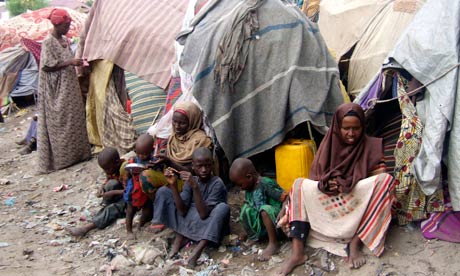 Somali refugees sit outside their makeshift home in Mogadishu, Somalia, after fleeing the south of the country. Thousands of people have arrived in Mogadishu over the past two weeks seeking assistance and the number is increasing by the day. Photograph: Mohamed Sheikh Nor/AP
The British public has so far donated £9m to an appeal launched by the Disasters Emergency Committee (DEC), an umbrella group of British charities, for people experiencing severe food shortages in east Africa. The region has been hit by the most severe drought in 60 years, wiping out cattle and crops. This has left at least 10 million people in Ethiopia, Kenya, Somalia and the newly formed Republic of South Sudan in desperate need of food, water and emergency healthcare.
Can the situation in east Africa be defined as a famine?
Is there a famine early warning system?
After the 1984-85 famines, the US created the famine early warning system (Fews) to anticipate possible impending famines and advise policymakers on how they might be prevented. In 2000, the name was changed to the famine early warning systems network (Fews Net), a reflection of efforts to create and strengthen local food security information systems and warning systems within Africa with which the US could work. As far back as December 2009 Fews Net expressed concern at the food security situation in east Africa. In March 2011, the warnings from Fews Net grew more urgent, saying that relief efforts were inadequate to ease existing and expected food deficits and malnutrition. "The development of new strategies to reach affected households in restricted areas is especially critical," it said. "In addition, large scale contingency/response planning should begin immediately given that a failure of the March - May rains would result in a major crisis." The report also said in the worst case scenario "localised famine conditions, including significantly increased child mortality," were possible.
When did aid agencies first appeal for money?
Towards last year, the UN appealed for $500m (£310m) for Ethiopia, Somalia and Kenya to address food insecurity, but only half had been funded as of early this month, while a $30m appeal for Djibouti reached just 30% of the target. Juneja says early warning systems in November 2010 had highlighted the erratic rainfall throughout last year and that there had been subsequent alerts pointing to the deteriorating situation. Juneja attributed the shortfall in funding to a combination of the global financial crisis, with governments and the public tightening their belts, and to "donor fatigue" after other disasters. In recent years, the world has been asked to raise money for the Pakistan floods and the Japanese earthquake and tsunami. A joint statement from the FAO, the World Food Programme and Oxfam last week admitted: "We are already behind the curve, having lost a narrow window of opportunity to begin building upon food security gains in the Horn of Africa following several seasons of successful rains and harvests that had reduced the number of hungry people."
Has the appeal for money come too late?
Camilla Knox-Peebles, who specialises in food security for Oxfam, believes the appeal could have come sooner as the situation was already bad in 2009-10. "Every year the harvest was worse, people became more hungry and people were becoming less resilient," she says. But Knox-Peebles and others have pointed out that it is difficult to sound the alarm when the problem is one of incremental deterioration. Even the early warning systems talked in predictive terms, discussing possible scenarios and could not state categorically that a crisis is a complete certainty. "It is hard to get funding to tackle deeper-seated problems until there is an emergency," said Knox-Peebles. The situation is difficult for relief groups, which to an extent rely on media reports to bring home the scale of the problem to the public. The DEC launched its appeal last week following the lead given by the UN, when Baroness Amos, the head of humanitarian affairs, asked for donors to "dig deep". The decision by the Department for International Development to give £38m to Ethiopia, paved the way for charities to launch their appeal. They have been careful to avoid the word famine, though, as they do not want to be accused of being alarmist. "It's a difficult balancing act," said a DEC official. "We have to raise the alarm before it's too late, but we have to be factual, we do not want to give misleading information and we do not want to be accused of 'crying wolf'."
What is the long-term solution?
Everybody knows the answers: full funding of emergency requirements to stop hunger and malnutrition from accelerating and support of safety net programmes, such as school feeding and local purchase, supporting small farmers with tools, seeds, fertilisers, food-based nutrition and the knowledge needed to boost agricultural production and sustain rural livelihoods, support policies and investments that address challenges such as climate change adaptation, preparedness and disaster risk reduction. The problem is getting there. The signs of optimism is that agriculture is now high on the international agenda. In 2009, the G8 club of rich countries pledged $22bn for agriculture in the developing world over three years and last month, the G20 group of big economies agreed an action plan to improve food security.
East Africa's most severe drought in 60 years has left 10 million people desperately short of food. But what can be done, and should the call for help have been made sooner?
The British public has so far donated £9m to an appeal launched by the Disasters Emergency Committee (DEC), an umbrella group of British charities, for people experiencing severe food shortages in east Africa. The region has been hit by the most severe drought in 60 years, wiping out cattle and crops. This has left at least 10 million people in Ethiopia, Kenya, Somalia and the newly formed Republic of South Sudan in desperate need of food, water and emergency healthcare.
Can the situation in east Africa be defined as a famine?
There has not been an official famine since 1984-85, when around 1 million people in Ethiopia and Sudan died. A famine is measured by rates of hunger, malnutrition and deaths, but the key to it is that it must be widespread, says Oxfam. Manoj Juneja, the new deputy director general of the Food and Agriculture Organisation, describes famine as a situation where there is an absolute exhaustion of, or inacessibility of, food in a given area leading to death. The situation in the Horn of Africa, says Juneja, has not reached that stage, but it is in a state of severe food insecurity that could rapidly deteriorate. "The situation demands immediate and constant attention," he says. In fact, famine as defined by the Food Security and Nutrition Analysis Unit (FSNA) based in Somalia has very precise criteria. The FSNA, started by the World Food Programme and funded by USAid, uses an integrated phase classification (IPC) five-point scale, ranging from "generally food secure" (1) to "catastrophe/famine" (5). Large areas of south east Ethiopia, southern Somalia and north east Kenya are already in phase four, the "emergency" phase. Some of the characteristics of phase five include acute malnutrition reaching more than 30%; deaths from hunger are two or more people per 10,000; water consumption is less than four litres a day; and intake of kilocalories is 1,500 a day compared to the recommended 2,100 a day.
After the 1984-85 famines, the US created the famine early warning system (Fews) to anticipate possible impending famines and advise policymakers on how they might be prevented. In 2000, the name was changed to the famine early warning systems network (Fews Net), a reflection of efforts to create and strengthen local food security information systems and warning systems within Africa with which the US could work. As far back as December 2009 Fews Net expressed concern at the food security situation in east Africa. In March 2011, the warnings from Fews Net grew more urgent, saying that relief efforts were inadequate to ease existing and expected food deficits and malnutrition. "The development of new strategies to reach affected households in restricted areas is especially critical," it said. "In addition, large scale contingency/response planning should begin immediately given that a failure of the March - May rains would result in a major crisis." The report also said in the worst case scenario "localised famine conditions, including significantly increased child mortality," were possible.
When did aid agencies first appeal for money?
Towards last year, the UN appealed for $500m (£310m) for Ethiopia, Somalia and Kenya to address food insecurity, but only half had been funded as of early this month, while a $30m appeal for Djibouti reached just 30% of the target. Juneja says early warning systems in November 2010 had highlighted the erratic rainfall throughout last year and that there had been subsequent alerts pointing to the deteriorating situation. Juneja attributed the shortfall in funding to a combination of the global financial crisis, with governments and the public tightening their belts, and to "donor fatigue" after other disasters. In recent years, the world has been asked to raise money for the Pakistan floods and the Japanese earthquake and tsunami. A joint statement from the FAO, the World Food Programme and Oxfam last week admitted: "We are already behind the curve, having lost a narrow window of opportunity to begin building upon food security gains in the Horn of Africa following several seasons of successful rains and harvests that had reduced the number of hungry people."
Has the appeal for money come too late?
Camilla Knox-Peebles, who specialises in food security for Oxfam, believes the appeal could have come sooner as the situation was already bad in 2009-10. "Every year the harvest was worse, people became more hungry and people were becoming less resilient," she says. But Knox-Peebles and others have pointed out that it is difficult to sound the alarm when the problem is one of incremental deterioration. Even the early warning systems talked in predictive terms, discussing possible scenarios and could not state categorically that a crisis is a complete certainty. "It is hard to get funding to tackle deeper-seated problems until there is an emergency," said Knox-Peebles. The situation is difficult for relief groups, which to an extent rely on media reports to bring home the scale of the problem to the public. The DEC launched its appeal last week following the lead given by the UN, when Baroness Amos, the head of humanitarian affairs, asked for donors to "dig deep". The decision by the Department for International Development to give £38m to Ethiopia, paved the way for charities to launch their appeal. They have been careful to avoid the word famine, though, as they do not want to be accused of being alarmist. "It's a difficult balancing act," said a DEC official. "We have to raise the alarm before it's too late, but we have to be factual, we do not want to give misleading information and we do not want to be accused of 'crying wolf'."
What is the long-term solution?
Everybody knows the answers: full funding of emergency requirements to stop hunger and malnutrition from accelerating and support of safety net programmes, such as school feeding and local purchase, supporting small farmers with tools, seeds, fertilisers, food-based nutrition and the knowledge needed to boost agricultural production and sustain rural livelihoods, support policies and investments that address challenges such as climate change adaptation, preparedness and disaster risk reduction. The problem is getting there. The signs of optimism is that agriculture is now high on the international agenda. In 2009, the G8 club of rich countries pledged $22bn for agriculture in the developing world over three years and last month, the G20 group of big economies agreed an action plan to improve food security.


