Scott Baldauf
From the Christian Science Monitor News Service Feb 7 2011
ANTANANARIVO, Madagascar — In March 2009, civilian protesters led by a baby-faced former disc jockey swarmed through the streets of this hilly capital city. They were calling for the ouster of then-President Marc Ravalomanana for what they saw as literally giving away the farm, selling out his impoverished nation.
The anger was about food. Mr. Ravalomanana reportedly had leased 3.2 million acres – nearly half the island nation's arable land – to a South Korean conglomerate, Daewoo, for 99 years. In theory, it should have been a win-win deal: Daewoo would pay Madagascar $6 billion to grow corn and oil palm, helping South Korea meet both its food-security and bio-fuels needs, while providing Madagascar with revenues and desperately needed jobs.
But the protests, ultimately backed by the military, showed that the Madagascan people – 70 percent of whom live in rural areas and nearly 50 percent of whom suffer chronic malnutrition – saw the deal as a "land grab" and a threat to their country's survival. Ravalomanana fled the country within days, and a military-backed junta led by the young DJ, Andry Rajoelina, took control. The Daewoo deal was promptly scuttled.
"There was no process," says Hajo Andrianainarivelo, Madagascar's new minister for land management. "The head government official of the region just received an order from the president of the country to help the Korean people to find the most fertile land. That was it. You can't do that in Madagascar."
Perhaps not. But the attraction of Africa's last great resource – its fertile land – is drawing dozens of foreign corporations and even national governments to the African mainland, developing the same kind of agricultural plots contemplated by Daewoo in Madagascar.
Africa is drawing dozens of corporate giants like Daewoo and even governments of such nations as Saudi Arabia, the United Arab Emirates, Brazil, Japan, and even India (which is food self-sufficient) to grow the food and biofuel crops they need back home. The coup in Madagascar and food riots in Mozambique last August – which followed news of a similar food and biofuels deal with the European Union and Brazil – are a warning sign of the volatility of the global balance of wealth and poverty that foreign investors and African leaders face.
By all rights, Africa could be a breadbasket for the world. Its fertile land, lengthy rivers, and farm labor tempt investors from around the globe.
But the continent continues to import the bulk of its staple food items, including corn, wheat, and rice from richer countries. On paper, foreign investment in African agriculture should correct that trade imbalance and help Africa become food self-sufficient. With global food prices skyrocketing (see story, page 8), the demand for biofuels increasing, and the amount of arable land static, Africa is well situated to capitalize on global demand. And with its vast rural populations living on less than $1 a day, it would seem hungry for such deals.
So the continent's discontent with these deals takes many development experts by surprise. Almost any investment in a poor country generates jobs, tax revenues, and better skills for the future. But in today's Africa, investment in agriculture – even a $6 billion long-term deal like Daewoo's – is increasingly portrayed by the media and rights groups as "land-grabbing," neocolonialism, and even a threat to a country's ability to feed itself. And when many African countries are still unable to feed themselves, foreign investment can become the spark for revolution.
Madagascar looks quite unlike the lush tropical paradise portrayed in the Disney movie of the same name. In the dry season, viewed from a plane at 36,000 feet, the island off the southeast coast of the African mainland looks like a giant plate of potatoes au gratin. Every square inch of the island – an area roughly the size of Texas – is chopped up into small, overlapping, often parched, dust-colored terraced plots.
Farmed for centuries by traditional slash-and-burn techniques, Madagascar's soil is depleted, and the pressure of a growing population – now 19 million – means that farmers must struggle to feed more people with less fertile land.
How large well-funded corporate commercial farms can make a go of land that small subsistence farmers have given up on is a story of 20th-century farming technology and 21st-century venture capital funds. Like the green revolution, which favored those with access to modern tractors and irrigation, chemical fertilizers and pesticides, and specialized seeds, today's corporate farming groups like Daewoo have the technology and financial backing to make unused land bloom.
Without much of that kind of investment, Madagascar is a net food importer, with 40 to 50 percent of the population, by UNICEF estimates, suffering chronic malnutrition, even during good harvests.
"In some areas, people go without their main food staple, rice, for four to six months," says Patrice Charpentier, project manager for food security at Land O'Lakes, an aid group. "Production is erratic. People don't want to overproduce if they're not sure they can sell it on the market. So they produce just enough to survive."
In an average year, people are able to make do with the rice they have saved up and fruit they find in the wild. But the boom-and-bust period of 2007-08 was no average year. Driven by the pell-mell growth of China and India, which demanded increasing fuel and raw materials, crude oil prices surged upward.
The price spike was a temptation for large agricultural companies to divert corn intended for food staples like cornmeal into more profitable biofuels like ethanol instead. It was classic supply-and-demand economics, and it sparked a land rush to buy up farmland across Africa.
But for the ordinary African consumer, it was a disaster. Corn prices jumped 119 percent from June 2007 to June 2008.
The economic collapse in the United States and much of Europe helped to cool things off, but the sleepy world of African subsistence farming had changed forever: The 21st-century African land rush had begun.
The World Bank estimates that worldwide, 115 million acres of land are leased to foreign investors, and the bulk of that is in Africa. A small sampling of countries targeted by foreign agricultural investors documented in the past five years by the International Food Policy Research Institute includes:
Democratic Republic of Congo: 7 million acres secured by the Chinese firm ZTE to grow oil palm for biofuels; and 24.7 million acres offered to the South African farmers' union, AgriSA.
Mozambique: Nearly 250,000 acres secured by the Swedish firm Skebab to produce biofuels.
Tanzania: Nearly 1.25 million acres requested by the Saudi Arabian government for food production; more than 110,000 acres purchased by the British firm CAMS Group for biofuels made from sweet sorghum.
Sudan: 1.7 million acres secured by the South Korean government to grow wheat; nearly 1 million acres secured by US-based Jarch Capital; nearly 75,000 acres secured by the Abu Dhabi Fund for Development to grow corn and alfalfa.
Ethiopia: More than 32,000 acres secured by the German firm Flora EcoPower to produce biofuels.
Not all deals are made alike, to be sure. Deals on leased farmland to produce food do manage to create jobs and can also help to transfer state-of-the-art farming skills, such as erosion control, to the local farm-labor force. Deals to grow crops for biofuels sometimes also involve simple refining, which also creates jobs. But many land deals are decidedly one-sided, with all food produced sent away for export
"Setting aside the 'you're selling our land' histrionics," says a Western diplomat who has closely studied Madagascar's agriculture sector, "I think that countries of Africa would benefit from foreign investment by creating low-end jobs, some of it on larger commercial plantations and even some on the small-holder farms."
The key, this diplomat says, is to negotiate a deal that benefits the host country as much as it does the foreign investor. In the Daewoo deal – as with numerous similar deals involving companies from China, Saudi Arabia, Dubai, and elsewhere – all the food produced in Madagascar was intended for export.
"The landlord country needs to be really thoughtful about the conditions of the investment contract," says the diplomat. "They have to be saying, 'We want this to be environmentally sustainable, so the commercial farmers are using best practices for soil conservation and water use. They should be carbon-neutral. They should bring in good technology and show local small-holder farmers how to use it, so the general productivity of the region increases.' "
Often, such long-term development goals are the furthest thing from the minds of the people who sign such deals. And in a region where government transparency is nearly nonexistent, the question of who benefits from a deal depends most upon who negotiated and signed it. In many poor countries of Africa, power is heavily centralized, often in the hands of a political elite that has ruled more or less nonstop since independence in the early 1960s.
Legal systems little changed since colonial times don't offer individual farmers much protection in terms of land rights, and they offer little in terms of government assistance such as agricultural extension agencies. National leaders – sometimes more impressed by gleaming developments like glass-and-steel skyscrapers than by less-glamorous development like tractors and training – have often ignored farmers' needs. Even enlightened African leaders who see the benefit of improving the rural farm economy are often hampered by stodgy old laws and meet with resistance from a rural population that distrusts their motives.
"As much as 90 percent of Africa is under customary tenure, which means it's held by the state on behalf of the community, who are then given the customary right to the land," says Ruth Meinzen-Dick, a land-rights specialist at the Consultative Group on International Agriculture Research, the one responsible for India's green revolution in the 1960s.
Many African small-holder farmers know they can be moved off their land at any time, and the growing number of farming deals confirms their worst fears. As a result, many African farmers are reluctant to invest in their land or to improve their techniques, knowing the benefit may be taken away in the future.
"The question is, do people have an expectation that they will have their land in 10 years?" says Ms. Meinzen-Dick. "If they don't, they're not going to plant a tree that will give fruit later.... [T]hey're not going to make long-term decisions that increase their productivity."
Legal reforms in each of Africa's 53 nations may slowly start to improve the ability of small-holder farmers to lift themselves out of subsistence farming into more profitable and productive commercial agriculture. Many development agencies say Africa's best bet seems to be a bit of outside investment.
For a country like Madagascar – poor, rural, and increasingly young and unemployed – the attraction of foreign investment is easy to understand. The population doubles about every 25 years, but the amount of arable land doesn't. Madagascar's economy has grown little, if at all, since the French colonial era, but like many developing countries it needs to grow at a robust 8 to 10 percent just to absorb its growing population.
When Daewoo – the world's third-largest corporate importer of corn – came knocking, asking for access to some of Madagascar's relatively inexpensive agricultural land, Ravalomanana, Madagascar's president at the time, could hardly sign the deal fast enough.
For Daewoo, the 99-year deal to lease 3.2 million acres was sweet. The Madagascar government was prepared to lease a long stretch of coastline to grow corn and oil palm, all of it for export. Much of the land had fallen into disuse because it was in a part of the island that receives little rainfall. But deep underground, there is fossil water locked up in limestone formations, estimated to be enough to irrigate dryland crops for a century or more.
Daewoo's investment in drawing out the water would have revived the region's job prospects as well as its fallowed land.
"It was a lot of land that was not utilized, and it could have been utilized if you brought in modern technology, such as deep well irrigation systems," says a longtime foreign businessman based in Antananarivo who has access to the country's political elite. But local people still viewed that land as belonging to their ancestors, he adds, and were bound to oppose any deal with a foreign investor, unless the government took a leading role in helping to persuade them.
"But it was badly thought out, badly implemented, and it went south from there," says the businessman. "The farmers here have an unusual emotional attitude. It's not their land: It's their ancestors' land. If your mom is not from here, then you're not from here."
That sentiment becomes more apparent beyond the city limits of Antananarivo, where the tightly clustered homes give way to gentle rolling hills planted with vegetables, and where rice fields are often flooded knee-deep.
Farmers here close to the capital have advantages over their more remote brethren, such as the ability to sell cash crops like tomatoes and cucumbers for big-city prices.
It is beyond these areas, in the deep backcountry, where the farming economy doesn't work as well. There, explains UNICEF spokeswoman Sarah Johansson, rates of chronic malnutrition rival those of war-ravaged Afghanistan. She says UNICEF treated 11,000 Madagascan children in 2010 for severe malnutrition because they either did not have enough food or not enough variety in their diet. Many of the worst cases are in areas where most of the country's food is grown, adds Ms. Johansson, because subsistence farmers in Madagascar are quite conservative about trying out different crops and diversifying their diets with vegetables, choosing instead more reliable stomach-fillers like rice.
But farmers nearer the city face a host of perils, such as the greedy eyes of those with power. On the road from the capital airport toward downtown, a bare patch of ground that used to be a farm now sits idle, a spontaneous soccer field for village boys and a parking lot for trucks, surrounded by green rice paddies.
The land was confiscated from local farmers and sold off by the Ravalomanana government to a hotel developer. When the new government came in, the hotel project was canceled, but while courts work out appropriate punishments and compensation, the original owners must wait and are unable to start farming again.
The lives of elites who seal multimillion-dollar import deals in the restaurants of colonial-era hotels and a farmer like Rajaonary could hardly be more different.
Rajaonary says his political leaders simply don't understand how important land is to an ordinary Madagascan. It is one's cradle, table, home, workplace, and grave, he says.
"Land is holy," Rajaonary says, leaning on his hoe in the late-afternoon sun. "Land that I inherited from my ancestors – I couldn't sell it, because even now, after they died, it still belongs to them. They are watching what I am doing with the land. So I will do what they have done for me. I will pass my land along to my family, too."
This attitude – indeed, this gap in understanding within the culture here – helps to explain the extraordinary revolt of March 2009, which brought down the government. But it also makes any future foreign investment in Madagascar's agriculture sector very difficult.
"Nobody, no foreign investor, is going to come back here to go into farming," says the foreign businessman. "Emotionally, it would not be possible."
But while Madagascar has closed the door for now on big foreign investors, there is little sign in other parts of Africa that there's much holding back the great African land rush.
Whether motivated by altruism or by personal enrichment, African leaders increasingly see agriculture as an engine for growth and a ticket to prosperity.• In March 2009, civilian protesters led by a baby-faced former disc jockey swarmed through the streets of this hilly capital city. They were calling for the ouster of then-President Marc Ravalomanana for what they saw as literally giving away the farm, selling out his impoverished nation.
The anger was about food. Mr. Ravalomanana reportedly had leased 3.2 million acres – nearly half the island nation's arable land – to a South Korean conglomerate, Daewoo, for 99 years. In theory, it should have been a win-win deal: Daewoo would pay Madagascar $6 billion to grow corn and oil palm, helping South Korea meet both its food-security and bio-fuels needs, while providing Madagascar with revenues and desperately needed jobs.
But the protests, ultimately backed by the military, showed that the Madagascan people – 70 percent of whom live in rural areas and nearly 50 percent of whom suffer chronic malnutrition – saw the deal as a "land grab" and a threat to their country's survival. Ravalomanana fled the country within days, and a military-backed junta led by the young DJ, Andry Rajoelina, took control. The Daewoo deal was promptly scuttled.
"There was no process," says Hajo Andrianainarivelo, Madagascar's new minister for land management. "The head government official of the region just received an order from the president of the country to help the Korean people to find the most fertile land. That was it. You can't do that in Madagascar."
Perhaps not. But the attraction of Africa's last great resource – its fertile land – is drawing dozens of foreign corporations and even national governments to the African mainland, developing the same kind of agricultural plots contemplated by Daewoo in Madagascar.
Africa is drawing dozens of corporate giants like Daewoo and even governments of such nations as Saudi Arabia, the United Arab Emirates, Brazil, Japan, and even India (which is food self-sufficient) to grow the food and biofuel crops they need back home. The coup in Madagascar and food riots in Mozambique last August – which followed news of a similar food and biofuels deal with the European Union and Brazil – are a warning sign of the volatility of the global balance of wealth and poverty that foreign investors and African leaders face.
By all rights, Africa could be a breadbasket for the world. Its fertile land, lengthy rivers, and farm labor tempt investors from around the globe.
But the continent continues to import the bulk of its staple food items, including corn, wheat, and rice from richer countries. On paper, foreign investment in African agriculture should correct that trade imbalance and help Africa become food self-sufficient. With global food prices skyrocketing (see story, page 8), the demand for biofuels increasing, and the amount of arable land static, Africa is well situated to capitalize on global demand. And with its vast rural populations living on less than $1 a day, it would seem hungry for such deals.
So the continent's discontent with these deals takes many development experts by surprise. Almost any investment in a poor country generates jobs, tax revenues, and better skills for the future. But in today's Africa, investment in agriculture – even a $6 billion long-term deal like Daewoo's – is increasingly portrayed by the media and rights groups as "land-grabbing," neocolonialism, and even a threat to a country's ability to feed itself. And when many African countries are still unable to feed themselves, foreign investment can become the spark for revolution.
Madagascar Looks quite unlike the lush tropical paradise portrayed in the Disney movie of the same name. In the dry season, viewed from a plane at 36,000 feet, the island off the southeast coast of the African mainland looks like a giant plate of potatoes au gratin. Every square inch of the island – an area roughly the size of Texas – is chopped up into small, overlapping, often parched, dust-colored terraced plots.
Farmed for centuries by traditional slash-and-burn techniques, Madagascar's soil is depleted, and the pressure of a growing population – now 19 million – means that farmers must struggle to feed more people with less fertile land.
How large well-funded corporate commercial farms can make a go of land that small subsistence farmers have given up on is a story of 20th-century farming technology and 21st-century venture capital funds. Like the green revolution, which favored those with access to modern tractors and irrigation, chemical fertilizers and pesticides, and specialized seeds, today's corporate farming groups like Daewoo have the technology and financial backing to make unused land bloom.
Without much of that kind of investment, Madagascar is a net food importer, with 40 to 50 percent of the population, by UNICEF estimates, suffering chronic malnutrition, even during good harvests.
"In some areas, people go without their main food staple, rice, for four to six months," says Patrice Charpentier, project manager for food security at Land O'Lakes, an aid group. "Production is erratic. People don't want to overproduce if they're not sure they can sell it on the market. So they produce just enough to survive."
In an average year, people are able to make do with the rice they have saved up and fruit they find in the wild. But the boom-and-bust period of 2007-08 was no average year. Driven by the pell-mell growth of China and India, which demanded increasing fuel and raw materials, crude oil prices surged upward.
The price spike was a temptation for large agricultural companies to divert corn intended for food staples like cornmeal into more profitable biofuels like ethanol instead. It was classic supply-and-demand economics, and it sparked a land rush to buy up farmland across Africa.
But for the ordinary African consumer, it was a disaster. Corn prices jumped 119 percent from June 2007 to June 2008.
The economic collapse in the United States and much of Europe helped to cool things off, but the sleepy world of African subsistence farming had changed forever: The 21st-century African land rush had begun.
The World Bank estimates that worldwide, 115 million acres of land are leased to foreign investors, and the bulk of that is in Africa. A small sampling of countries targeted by foreign agricultural investors documented in the past five years by the International Food Policy Research Institute includes:
Democratic Republic of Congo: 7 million acres secured by the Chinese firm ZTE to grow oil palm for biofuels; and 24.7 million acres offered to the South African farmers' union, AgriSA.
Mozambique: Nearly 250,000 acres secured by the Swedish firm Skebab to produce biofuels.
Tanzania: Nearly 1.25 million acres requested by the Saudi Arabian government for food production; more than 110,000 acres purchased by the British firm CAMS Group for biofuels made from sweet sorghum.
Sudan: 1.7 million acres secured by the South Korean government to grow wheat; nearly 1 million acres secured by US-based Jarch Capital; nearly 75,000 acres secured by the Abu Dhabi Fund for Development to grow corn and alfalfa.
Ethiopia: More than 32,000 acres secured by the German firm Flora EcoPower to produce biofuels.
Not all deals are made alike, to be sure. Deals on leased farmland to produce food do manage to create jobs and can also help to transfer state-of-the-art farming skills, such as erosion control, to the local farm-labor force. Deals to grow crops for biofuels sometimes also involve simple refining, which also creates jobs. But many land deals are decidedly one-sided, with all food produced sent away for export
"Setting aside the 'you're selling our land' histrionics," says a Western diplomat who has closely studied Madagascar's agriculture sector, "I think that countries of Africa would benefit from foreign investment by creating low-end jobs, some of it on larger commercial plantations and even some on the small-holder farms."
The key, this diplomat says, is to negotiate a deal that benefits the host country as much as it does the foreign investor. In the Daewoo deal – as with numerous similar deals involving companies from China, Saudi Arabia, Dubai, and elsewhere – all the food produced in Madagascar was intended for export.
"The landlord country needs to be really thoughtful about the conditions of the investment contract," says the diplomat. "They have to be saying, 'We want this to be environmentally sustainable, so the commercial farmers are using best practices for soil conservation and water use. They should be carbon-neutral. They should bring in good technology and show local small-holder farmers how to use it, so the general productivity of the region increases.' "
Often, such long-term development goals are the furthest thing from the minds of the people who sign such deals. And in a region where government transparency is nearly nonexistent, the question of who benefits from a deal depends most upon who negotiated and signed it. In many poor countries of Africa, power is heavily centralized, often in the hands of a political elite that has ruled more or less nonstop since independence in the early 1960s.
Legal systems little changed since colonial times don't offer individual farmers much protection in terms of land rights, and they offer little in terms of government assistance such as agricultural extension agencies. National leaders – sometimes more impressed by gleaming developments like glass-and-steel skyscrapers than by less-glamorous development like tractors and training – have often ignored farmers' needs. Even enlightened African leaders who see the benefit of improving the rural farm economy are often hampered by stodgy old laws and meet with resistance from a rural population that distrusts their motives.
"As much as 90 percent of Africa is under customary tenure, which means it's held by the state on behalf of the community, who are then given the customary right to the land," says Ruth Meinzen-Dick, a land-rights specialist at the Consultative Group on International Agriculture Research, the one responsible for India's green revolution in the 1960s.
Many African small-holder farmers know they can be moved off their land at any time, and the growing number of farming deals confirms their worst fears. As a result, many African farmers are reluctant to invest in their land or to improve their techniques, knowing the benefit may be taken away in the future.
"The question is, do people have an expectation that they will have their land in 10 years?" says Ms. Meinzen-Dick. "If they don't, they're not going to plant a tree that will give fruit later.... [T]hey're not going to make long-term decisions that increase their productivity."
Legal reforms in each of Africa's 53 nations may slowly start to improve the ability of small-holder farmers to lift themselves out of subsistence farming into more profitable and productive commercial agriculture. Many development agencies say Africa's best bet seems to be a bit of outside investment.
For a country like Madagascar – poor, rural, and increasingly young and unemployed – the attraction of foreign investment is easy to understand. The population doubles about every 25 years, but the amount of arable land doesn't. Madagascar's economy has grown little, if at all, since the French colonial era, but like many developing countries it needs to grow at a robust 8 to 10 percent just to absorb its growing population.
When Daewoo – the world's third-largest corporate importer of corn – came knocking, asking for access to some of Madagascar's relatively inexpensive agricultural land, Ravalomanana, Madagascar's president at the time, could hardly sign the deal fast enough.
For Daewoo, the 99-year deal to lease 3.2 million acres was sweet. The Madagascar government was prepared to lease a long stretch of coastline to grow corn and oil palm, all of it for export. Much of the land had fallen into disuse because it was in a part of the island that receives little rainfall. But deep underground, there is fossil water locked up in limestone formations, estimated to be enough to irrigate dryland crops for a century or more.
Daewoo's investment in drawing out the water would have revived the region's job prospects as well as its fallowed land.
"It was a lot of land that was not utilized, and it could have been utilized if you brought in modern technology, such as deep well irrigation systems," says a longtime foreign businessman based in Antananarivo who has access to the country's political elite. But local people still viewed that land as belonging to their ancestors, he adds, and were bound to oppose any deal with a foreign investor, unless the government took a leading role in helping to persuade them.
"But it was badly thought out, badly implemented, and it went south from there," says the businessman. "The farmers here have an unusual emotional attitude. It's not their land: It's their ancestors' land. If your mom is not from here, then you're not from here."
That sentiment becomes more apparent beyond the city limits of Antananarivo, where the tightly clustered homes give way to gentle rolling hills planted with vegetables, and where rice fields are often flooded knee-deep.
Farmers here close to the capital have advantages over their more remote brethren, such as the ability to sell cash crops like tomatoes and cucumbers for big-city prices.
It is beyond these areas, in the deep backcountry, where the farming economy doesn't work as well. There, explains UNICEF spokeswoman Sarah Johansson, rates of chronic malnutrition rival those of war-ravaged Afghanistan. She says UNICEF treated 11,000 Madagascan children in 2010 for severe malnutrition because they either did not have enough food or not enough variety in their diet. Many of the worst cases are in areas where most of the country's food is grown, adds Ms. Johansson, because subsistence farmers in Madagascar are quite conservative about trying out different crops and diversifying their diets with vegetables, choosing instead more reliable stomach-fillers like rice.
But farmers nearer the city face a host of perils, such as the greedy eyes of those with power. On the road from the capital airport toward downtown, a bare patch of ground that used to be a farm now sits idle, a spontaneous soccer field for village boys and a parking lot for trucks, surrounded by green rice paddies.
The land was confiscated from local farmers and sold off by the Ravalomanana government to a hotel developer. When the new government came in, the hotel project was canceled, but while courts work out appropriate punishments and compensation, the original owners must wait and are unable to start farming again.
The lives of elites who seal multimillion-dollar import deals in the restaurants of colonial-era hotels and a farmer like Rajaonary could hardly be more different.
Rajaonary says his political leaders simply don't understand how important land is to an ordinary Madagascan. It is one's cradle, table, home, workplace, and grave, he says.
"Land is holy," Rajaonary says, leaning on his hoe in the late-afternoon sun. "Land that I inherited from my ancestors – I couldn't sell it, because even now, after they died, it still belongs to them. They are watching what I am doing with the land. So I will do what they have done for me. I will pass my land along to my family, too."
This attitude – indeed, this gap in understanding within the culture here – helps to explain the extraordinary revolt of March 2009, which brought down the government. But it also makes any future foreign investment in Madagascar's agriculture sector very difficult.
"Nobody, no foreign investor, is going to come back here to go into farming," says the foreign businessman. "Emotionally, it would not be possible."
But while Madagascar has closed the door for now on big foreign investors, there is little sign in other parts of Africa that there's much holding back the great African land rush.
Whether motivated by altruism or by personal enrichment, African leaders increasingly see agriculture as an engine for growth and a ticket to prosperity.
http://www.minnpost.com/worldcsm/2011/02/07/25540/hunger_and_food_security_is_africa_selling_the_farm

 Flickr/IITA Image Library
 This graph published in the Africa Progress Report 2011 shows how steady African growth was interrupted by the global financial crisis in 2009 but is expected to regain its momentum through 2011.
 Photograph: Graham Turner for the Guardian: European market support for UK agriculture, including the arable sector, is set to diminish over the next three years.
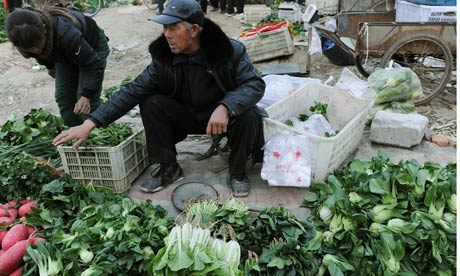 Vegetable sellers wait for customers at their stalls in a street market in Hefei, eastern China. Recent food price surges in the country have underscored the supply challenges it faces. Photograph: Str/AFP/Getty Images

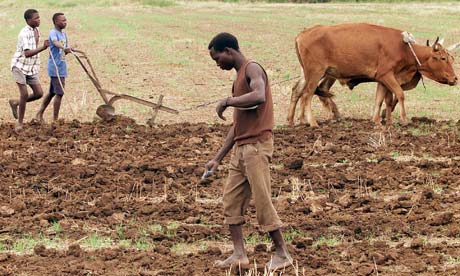 Photograph: Howard Burditt/Reuters: Food production in Africa is 10% lower than it was in 1960.


