Showing posts with label economics of poverty. Show all posts

Sunday, 24 July 2011

POVERTY: Canada: Poverty comes with a high price

Iglika Ivanova, Times Colonist July 16, 2011


Poverty comes with a high price : Failing to address the root cause is expensive in current and future costs

Poverty is costing British Columbians a lot more than a few cans of non-perishable food and a new toy donated at Christmas.
A study by the Canadian Centre for Policy Alternatives estimates that poverty costs the average man, woman and child in B.C. as much as $2,100 each, every year.
The cost adds up to $8.1 billion to $9.2 billion per year, close to five per cent of the total value of our economy. Failing to address the root causes of poverty is expensive, in both current and future costs.
Study after study has linked poverty to poorer health, lower literacy, more crime, poor school performance for children and greater stress for families.
Poverty takes an enormous toll on the people who struggle with it, but society at large pays a very high price.
British Columbians pay about $1.2 billion per year in higher public health care costs linked to poverty. We spend another $745 million annually on policing and criminal justice costs, driven by poverty-related crime. Higher costs of income supports and lost tax revenues that come with inadequate earnings account for more than $900 million per year.
Poverty also acts as a significant drag on our economy. We all lose out when people are excluded from the workforce because they don't have access to the supports or training they need to do better, or when they are stuck in low-wage jobs in our polarized labour market.
Underusing the human potential of poor British Columbians to contribute to society and to our economy is among the biggest costs of poverty ($6.3 billion to $7.2 billion per year).
This is a conservative assessment, as our estimates do not capture all of the costs of poverty.
Notably, we exclude the costs that child poverty imposes on future generations by perpetuating the cycle of poverty. We also do not measure many of the less tangible costs, such as the impact of high poverty levels on social cohesion and our feelings of safety in our communities. Nor do we include the direct cost of providing front-line social services to those in poverty.
The government's approach to poverty is to deal with negative consequences as they arise. This is akin to handling a leaky roof by repeatedly mopping the floor. It makes things look passable when the guests arrive, but it does nothing to address the root causes. And like a leaky roof, poverty's consequences only get harder and more expensive to fix the more we put off dealing with them.
Governments often balk at the high costs of policies that would effectively reduce poverty, such as building more social housing, increasing welfare rates and funding high-quality public early learning programs for all children.
This kind of thinking assumes that sticking to the status quo of keeping one in nine British Columbians in poverty is free. This is not true, as our study demonstrates.
Seven Canadian provinces have recognized the high cost of poverty and have implemented poverty reduction strategies, or are developing them. Poverty reduction has emerged as an issue that transcends party politics and ideology to receive all-party agreement in most provinces.
B.C. should follow their lead and introduce an all-partyendorsed, comprehensive poverty reduction plan with legislated targets and timelines.
We estimate that once fully implemented, such a plan would cost between $3 and $4 billion per year. That's less than half of what poverty is costing us now.
The economic case for government action on poverty is strong. In the long run, it is cheaper to address the root causes of poverty directly than to continue to pay for the longterm consequences of poverty year after year.
It's time for our government to rise to the challenge and commit to a comprehensive plan to systematically tackle the root causes of poverty. It is the right thing to do. And it's also the fiscally responsible thing to do.
The biggest challenge is that up-front investments are needed to bring savings down the line. The four-year election cycle hardly encourages long-term thinking or investments.
What's needed is leadership, vision and a willingness to do the right thing.

Iglika Ivanova is an economist and the public interest researcher at the Canadian Centre for Policy Alternatives' B.C. office.

http://www.timescolonist.com/business/Comment+Poverty+comes+with+high+price/5113491/story.html#ixzz1T1eZVvfD

Monday, 25 April 2011

POVERTY: What Does Adam Smith’s Linen Shirt Have to do with Global Poverty?


Martin Ravallion 2011-04-18

In his Inquiry into the Nature And Causes of the Wealth of Nations Adam Smith pointed to the social-inclusion role of a linen shirt in 18th century Europe:


Adam Smith. Photo: Istockphoto.com“A linen shirt … is, strictly speaking, not a necessary of life. The Greeks and Romans lived, I suppose, very comfortably though they had no linen. But in the present times, through the greater part of Europe, a creditable day-labourer would be ashamed to appear in public without a linen shirt, the want of which would be supposed to denote that disgraceful degree of poverty which, it is presumed, nobody can well fall into without extreme bad conduct.”


This passage has often been used to justify the view that poverty is not absolute but relative—that certain socially-specific expenditures are essential for social inclusion, on top of basic needs for nutrition and physical survival.

The way this idea is implemented in practice is to set a “relative poverty line” that is a constant proportion of average income for the country and date in question. That is how poverty is measured in most of Western Europe. By contrast, poverty measures in developing countries have almost invariably used absolute lines, which aim to have a fixed real value over time. The World Bank’s international “$1 a day” poverty lines also aim to be absolute lines across countries, using purchasing power parities from the International Comparison Program.
Yet much social science research in developing countries has confirmed the social roles of certain forms of consumption—just as Adam Smith had noted about a linen shirt in 18th century Europe. Anthropologists and economists have pointed out that festivals, celebrations and communal feasts are not just entertainment. They have an important social role in maintaining the networks that are crucial to coping with poverty and even escaping it. Household budget surveys have often revealed seemingly high expenditures on celebrations and festivals by very poor people. It is also known that clothing can serve an important social role. In many developing countries today one can see even very poor, and evidently undernourished, people with cell phones. And much research has also suggested that people in poor countries care about relative deprivation, as typically revealed through self-reported questions on happiness or satisfaction with life.
But such research findings do not imply that poverty lines should also be set at a constant proportion of the mean. This assumes (implicitly) that the cost of social inclusion needs are much lower for poor people—indeed, their cost goes to zero as incomes fall to zero. That is implied by a poverty line set at a constant proportion of average income. If we were to apply such an idea to poor countries—recognizing that poor people too have social inclusion needs—we would be saying that the cost of Adam Smith’s linen shirt can be virtually zero for the poorest person. But that makes no sense; the cost of a socially-acceptable linen shirt will not be zero, and will presumably be no different for a poor person. This is a troubling property of such poverty measures.
To come up with a feasible approach to measuring “relative poverty” that can span both poor and rich countries, Tony Atkinson and Francois Bourguignon (AB) have postulated two key capabilities, namely physical survival and social inclusion. The former is the capability of being adequately nourished and clothed for meeting the physical needs of survival and normal activities. On top of this, a person must also satisfy certain social inclusion needs. Each capability has a corresponding poverty line, giving the absolute and relative lines. AB proposed that one should only be deemed “not poor” if one is neither absolutely poor nor relatively poor.
However, AB follow the Western European model of assuming that the relative line is a constant proportion of the mean. This assumption needs to be dropped, to allow for the (strictly positive) cost of Adam Smith’s linen shirt. On doing so one gets the “weakly relative poverty lines” that I have proposed in a paper with Shaohua Chen, soon to be published here. The following figure shows how we implement the idea, using the same data set on national poverty lines that we used to derive the new international absolute line of $1.25 a day (as documented here).


The weakly relative line is $1.25 a day up to a mean consumption of $2 a day, and then rises with a slope of 1:3. The lower bound to the relative line is $0.60 a day, which can be thought of as the cost of Adam Smith’s linen shirt.
With economic growth, our weakly relative poverty lines tend to rise after some point, and proportionately more as average income rises. But they will never be proportionate to the mean. So if all incomes grow at the same rate, all poverty measures will show a decline. This is in marked contrast to the strongly relative measures, which will show no change even when incomes of the poor grow at the same rate as for others.
On implementing this schedule of weakly relative poverty lines using 700 surveys for 115 countries, Chen and I find that there is more relative poverty in the developing world than previously thought. And the pace of progress against relative poverty is slower than that against absolute poverty. We find that 47% of the population of the developing world lived in relative poverty in 2005, of which about half lived in absolute poverty, as measured by the $1.25 a day line. The incidence of relative poverty fell from 53% in 1990 and 63% in 1981. This was not a sufficient rate of decline in the incidence of poverty to prevent a rise in the number of poor. By contrast, the corresponding absolute poverty measures show falling poverty counts in the aggregate.
http://blogs.worldbank.org/developmenttalk/what-does-adam-smith-s-linen-shirt-have-to-do-with-global-poverty

Sunday, 17 April 2011

POVERTY: Tools for the Expert Economists

ADePT: Software Platform for Automated Economic Analysis — ADePT software was developed in the research department of the World Bank to automate and standardize economic analysis. ADePT is now freely available for download from this site for applied economics researchers willing to quickly and reliably analyse their data using most modern statistical and econometric techniques.
PovcalNet — An interactive computational tool that allows you to replicate the calculations made by the World Bank’s researchers in estimating the extent of absolute poverty in the world ($1 a day). It also allows you to calculate the poverty measures under different assumptions and to assemble the estimates using alternative country groupings or for any set of individual countries of your choosing. PovcalNet is self-contained. PovcalNet is a product of the World Bank's Development Research Group.

PovSTAT — an Excel based program that produces forecasts that vary by level of complexity depending on the availability of reliable data for the post survey period and on the extent to which various factors influencing poverty levels are incorporated. You will find a chapter describing the tool, as well as a file with the program itself.
http://web.worldbank.org/WBSITE/EXTERNAL/TOPICS/EXTPOVERTY/0,,contentMDK:20271992~menuPK:497971~pagePK:148956~piPK:216618~theSitePK:336992~isCURL:Y,00.html


POVERTY: How to Attack Global Poverty? A Q&A With the Authors of More Than Good Intentions


Stephen J. Dubner : April 14, 2011
 Photo: iStockphoto

The experts generally fall into two camps when it comes to alleviating global poverty: those who believe we simply need to spend more money in more places; and those who think that too many billions have already been spent too inefficiently and ineffectively, requiring a new and smarter approach to aid.
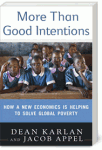
In a new book called More Than Good Intentions: How a New Economics Is Helping to Solve Global Poverty,
Freakonomics blog contributor Dean Karlan, a development economist at Yale, and Jacob Appel, a researcher at Innovations for Poverty Action, describe the split:
Each camp claims prominent economists as adherents: Jeffrey Sachs of Columbia University, an adviser to the United Nations, and Bill Easterly of New York University, a former senior official at the World Bank. Sachs and his supporters regale us with picture-perfect transformational stories. Easterly and the other side counter with an equally steady supply of ghastly the-world-is-corrupt-and-everything-fails anecdotes. The result? Disagreement and uncertainty, which leads to stagnation and inertia — in short, a train wreck. And no way forward.
Karlan and Appel argue for a third way, one that draws from behavioral economics and relies on rigorous evaluation. To wit:
Three questions organize our discussions. First: what is the root cause of the problem? Using both behavioral and traditional economics to answer this question is exactly the first prong of our attack in this book. Then two more questions: Does the “idea” at hand, whether a government policy, NGO intervention, or business, actually solve the problem? And how much better off is the world because of it? Using rigorous evaluations to answer these two questions together is the second prong of our attack.
 Here’s the table of contents from their book:
1. Introduction: The Monks and the Fish
2. To Work Against Poverty: How We Do What We Do
3. To Buy: Doubling the Number of Families with a Safety Net
4. To Borrow: Why the Taxi Driver Didn’t Take a Loan
5. To Pursue Happiness: Having Better Things to Do
6. To Cooperate in Groups: What About the Weakness of the Crowd?
7. To Save: The Unfun Option
8. To Farm: Something from Nothing
9. To Learn: The Importance of Showing Up
10. To Stay Healthy: From Broken Legs to Parasites
11. To Mate: The Naked Truth
12. To Give: The Takeaway
http://www.freakonomics.com/2011/04/14/how-to-attack-global-poverty-a-qa-with-the-authors-of-more-than-good-intentions/

Monday, 25 October 2010

POVERTY: The Mystery of Economic Growth

AKASH KAPUR October 21, 2010
EDAYANCHAVADI, INDIA — Around here, in rural South India, development over the last few decades has been an uneven process.
Some people rise, others fall. Some get rich, some stay poor.
The rich build concrete houses, buy motorcycles and send their children to private schools. The poor live in thatch huts, work part-time as agricultural laborers and pull their children out of school young.
Development is an unpredictable business. The rich and poor often grow up in the same village. They are beneficiaries, or victims, of the same government policies. Their lives are determined by the same weather patterns and infrastructural constraints.
One of the central questions facing India — and, indeed, the developing world as a whole — is why some people, or countries, move ahead, while others fall behind.
An answer to this question would have huge implications for public policy. In India, torn between an attachment to socialism and a new infatuation with capitalism, it could help find a balance between the state and markets in poverty alleviation schemes.
More generally, as India continues to grow rapidly, a better understanding of its path to development might be applied to other regions of the world, where poverty is proving less tractable.
For all its temptations, however, the search for a policy toolkit toward development is fraught with pitfalls. Over the last 60 years or so, the international development community has come up with model after model, theory after theory, in search of just such a toolkit.
It has, at various times, promoted the benefits of huge, often conditional, inputs of foreign aid, the rigors of shock therapy, the virtues of free trade and the promise of the Washington Consensus (a set of policies prescribed and often imposed by agencies like the World Bank, the International Monetary Fund and the U.S. Treasury).
Yet for all the efforts to come up with a general theory of development, the truth is that economic growth remains something of a mystery. This is the conclusion of a recent anthology, “What Works in Development?”, published by the Brookings Institution. The essays lead to the conclusion that there is no clear way to ease poverty, and — as the editors, William Easterly and Jessica Cohen, state in their introduction — “no consensus on ‘what works’ for growth and development.”
Mr. Easterly, a former World Bank economist, has elsewhere shown that there is little correspondence between a nation’s economic growth and the extent to which it follows international development prescriptions. Analyzing data for 1980 to 2002, he found that countries that grew the fastest received considerably less foreign aid and spent less time under I.M.F. tutelage than those that grew the slowest. This doesn’t mean that following the orthodoxy harms development, but it does suggest that rapid growth is possible without international aid or advice.
Part of the problem, it turns out, may be the very attempt to follow a model. Progress — economic or otherwise — is a notoriously subjective phenomenon. It is context sensitive, and highly dependent on local conditions. It is, in particular, resistant to the uniformity implicit in even the most sophisticated models.
This view, once held by a fringe, is entering the mainstream. It was given voice last month by none other than Robert B. Zoellick, president of the World Bank, when he spoke of the need for “rethinking” development economics and “a questioning of prevailing paradigms.”
Facts speak for themselves. It has become increasingly evident that many of the most successful growth stories have resulted not from slavishly following an external set of policy directives, but from pursuing unconventional — and locally attuned — solutions.
The rise of Southeast Asia (and more recently China), for example, represented a repudiation of textbook views about the proper role of the government and of the relationship between markets and the state.
India’s recent growth, too, can be seen as a result of a determination to follow its own path. While it is true that the country began its climb out of socialist torpor under World Bank and I.M.F. supervision, many aspects of its growth since then contravene the conventional model. A notable example is the country’s refusal to fully liberalize its capital markets or allow unrestricted foreign investment. This refusal, lamented by advocates of the Washington Consensus, is now credited with having spared India the worst of the recent financial crisis.
Jessica Wallack, an economist who heads the Center for Development Finance, a research organization in Chennai, suggests, also, that India may have benefited in some ways from moving slowly toward the privatization of public assets (again, a contravention of development orthodoxy). She argues that, given social inequality, corruption and limited institutional capacity, rapid privatization could, much as in the former Soviet Union, have “resulted in greater concentration of wealth in a few people’s hands.”
A further example might be the nation’s Mahatma Gandhi National Rural Employment Guarantee Act, a major public works program that has dismayed those who advocate market solutions to unemployment, yet that is undeniably easing poverty in much of rural India.
Each of these policies has a price. But their salient feature (and, arguably, the reason for their relative success) is a sensitivity to context — the fact that they are responses to genuine needs, and that they are designed taking into account particular local conditions, such as the reality of corruption.
Ultimately, it is this sensitivity, this ability to accommodate context and local detail, that works best in development. The type of grinding, sweaty work it implies — time in the field, in villages and on farms, learning about cultures and social structures — is certainly less glamorous than designing overarching theories to rid the world of poverty.
But poverty is an unglamorous business. It is only fitting that the most effective way to address it would be through small, low-key and often backbreaking interventions.
Join an online conversation at http://www.akashkapur.com/

http://www.nytimes.com/2010/10/22/world/asia/22iht-letter.html