Showing posts with label malaria history. Show all posts

Friday, 17 June 2011

MALARIA: History: Malaria, Protestants, and Google

Benjamin James Reilly
Did the Protestant Reformation inadvertently liberate Northern Europe from a long-standing demographic drain exerted by Rome's indigenous P. falciparum malaria? Perhaps, but the existing scholarship on Northern European travel to Rome is only suggestive, not conclusive. Although the presence of P. falciparum in Rome in historical times is well established, literature on Northern European travel to Rome draws from scattered and anecdotal evidence, thus rendering inconclusive their finding that Northern European travel to Rome declined after the Reformation. Seeking corroboration, I performed a statistical analysis of travel to Rome using a novel source: names taken from an archive of nearly 3,000 web pages generated by targeted search engine queries in three languages. The highly suggestive results obtained by this method not only support the original thesis, but also might serve as a guide for other scholars seeking data samples for untraditional environmental history research.
http://envhis.oxfordjournals.org/content/16/2/312.abstract?maxtoshow=&hits=18&RESULTFORMAT=&andorexacttitle=and&andorexacttitleabs=and&fulltext=malaria&andorexactfulltext=and&searchid=1&usestrictdates=yes&resourcetype=HWCIT&ct

Thursday, 9 June 2011

MALARIA: History: Remedies from European herbals from the 16th and 17th century

Journal of Ethnopharmacology Volume 133, Issue 2, 27 January 2011, Pages 278-288

Michael Adamsa, , , Wandana Althera, Michael Kesslerb, Martin Klugeb and Matthias Hamburgera

Abstract
Background
From antiquity up into the 20th century tertian and quartan malaria which are caused by the parasites Plasmodium vivax and Plasmodium malariae were widespread in Central Europe. Hundreds of different remedies against malaria can be found in herbals from the Renaissance.

Aim of the study
To document and discuss from a modern pharmacological viewpoint the old remedies described in eight 16th and 17th century herbals written in German.

Materials and methods
Eight of the most important herbals of the 16th and17th century including Bock (1577), Fuchs (1543), Matthiolus (1590), Lonicerus (1560), Brunfels (1532), Zwinger (1696), and Tabernaemontanus (1591 and 1678) were searched for terms related to malaria, and documented plants and recipes described for its treatment. Additionally the overlapping of these remedies with those in De Materia Medica by the Greek physician Dioscorides was studied.

Results
Three hundred and fourteen taxa were identified in the herbals for this indication. Recent pharmacological data was found for just 5% of them. The influence of De Materia Medica was shown to be negligible with only 3.5% of the remedies in common.

Conclusions
European Renaissance herbals may be a valuable source of information for the selection of plants for focussed antiplasmodial screening programmes, but have received only little scientific attention. Antimalarial remedies from these herbals must be viewed as independent sources of knowledge separate from Dioscorides’ De Materia Medica.

Monday, 27 December 2010

MALARIA: Spain: Historical aspects


Every summer thousands of us travel to exotic climes with mosquito nets, jungle-strength cream and anti-malarial drugs. But how 'foreign' really is Malaria to Spain and Europe ?
Despite all the concern about climate change enabling malaria to spread to the West, the weather is by no means the biggest factor in determining the presence of malarial mosquitoes. Europe was until the last century rife with the disease. In fact, the last country in Western Europe to eradicate malaria was cold, damp Holland in the late nineteen-sixties.
Malaria, or 'paludismo' as it is also known in Castilian, was endemic to Spain until well into the 20th century. Its existence has had a huge effect on the landscape in certain areas. Much of Spain 's wetland surface area has been drained in the fight to eradicate it. On the flip side, some sites like Doñana have to some extent been saved from extensive rice farming by the presence of malarial mosquitoes.
The disease probably took off from its ancestral enclaves with the Neolithic revolution between 8,000 and 10,000 BC. Sedentary life, the formation of the first villages, land clearance and crops irrigation, the increase in human population (thanks notably to the improvement in living conditions and food availability) certainly favoured the spread of malaria. New strands of resistant parasites would have been brought by the waves of invasions that swept across the Peninsula . We know for example that malaria followed Hannibal in his wake.
By the Middle Ages, kings and noblemen had gained control of the best wetlands for themselves, where they could hunt and earn lucrative profits by exploiting their natural resources (everything from rice cultivation to leech farming). However, these advantages were offset by the fear of marshes as breeding grounds of plagues and incurable fevers. As way of illustration, while the common European word comes from the Latin for 'bad airs', 'paludismo' comes from the Latin 'Palus' for lagoon. Such was the dread of these sites that a royal decree was passed in 11th-century Valencia sentencing any farmer to death who planted rice too close to villages and towns. For centuries afterwards, there was conflict between rice growers and the authorities who passed law after law restricting rice fields to wetlands that were unsuitable for other types of crops.
The disease continued to decimate local populations throughout the centuries and was to spread over the centuries with the increase in rice farming. The only areas relatively free of the disease were the colder northern statelets (Asturias, northern Navarra and Leon.). This north-south divide was patent in the organisation of the ventures of the Conquistadors; soldiers from Asturias , Galicia or Vizcaya would often be rejected for their tendency to suffer chapoteadas - marsh fevers. It was believed that people from malarial zones had developed a certain lucky immunity (I am unaware as to whether there is any real immunity among Spaniards as this is say among Sub-Saharan Africans). There is a long list of famous people who have died here from malaria ( Hannibal 's wife and son-see above, Emperor Isabel, Felipe II, Felipe IV, Felipe V, Fernando VI, Carlos II, Santa Teresa de Jesús, Hernán Cortés.).


Distribution of malaria in Spain in 1786.

An outbreak hit Barcelona in the 1880's as the city ran out of money to finish the Eixample, as is described by Robert Hughes in 'Barcelona'. As speculation sent prices sky high, thousands of investors went bust when the bubble burst and hundreds of plots were left bare for a decade. Here stagnant waters built up, a ripe environ for mosquito larva.
At the turn of the 20th century, malaria was considered the biggest single health risk by the Spanish authorities, and an estimated 800,000 people had malaria in Spain , with some 4,000 dying every year. This concern led to the passing of the Cambó Law in 1918, which gave legal backing to the already strong trend of wetland drainage since the mid-19th century. The law was often ineffective as it allowed for wetlands to be converted into rice fields, though it was responsible for the destruction of much of Spain 's wetland surface area until its repeal in the early 1980's.
Along with drainage, one of the most effective controls was the release in 1921 of a fish called 'gambusia' or mosquitofish, incidentally probably now the most widespread freshwater fish in the world. This little fish is a voracious devourer of mosquito larva and rapidly took to Iberian waters. Improvements in housing, public health and sanitation, and a falling rural population all helped to cut back the parasite, though the Civil War meant a temporary halt to its retreat. Four years after it finished, in 1943, a final serious outbreak hit the country with 400,000 people affected and 1,250 deaths, but by the end of the forties it had been effectively controlled and restricted to a few pockets, with the use of DDT from 1947 onwards delivering the coup de grace .
The defeat of malaria
Malaria was declared officially eradicated in 1964, which was just in time for mass tourism, which certainly would not have taken off had it not been for the parasite's prior eradication. It also coincided nicely with the UN no longer classifying Spain as a Third World country. As all development workers know, malaria is eradicated by means of progress, not by a change in the temperature or necessarily draining all wetlands.
Malaria could indeed return to Europe , but the real trigger would be a massive economic meltdown rather than any rise in temperature, which would only make matters worse.

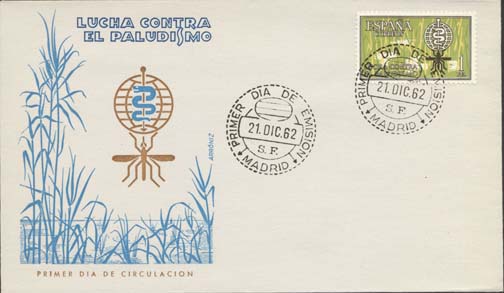
  Spanish first-day cover in support of the UN's world anti-malarial campaign of 1962, just before the disease was delared erradicated from the country.
Malaria update
Nothing to do with Spain, but following on from the 'Malaria in Spain' thing, I've discovered that Holland wasn't the last place in Europe to be declared malaria-free. Thus: It was not until 1975 that the last pocket of indigenous malaria in Greek Macedonia was considered eliminated and the World Health Organization declared the continent free of the disease. [http://www.swissinfo.org/sen/swissinfo.html?siteSect=671&sid=1746755]
However, so called 'imported' as opposed to autochthonous malaria is an increasing problem in Spain and the EU. According to the WHO
Throughout Europe, imported malaria is a growing medical and health issue. Since the early 1970s, the reported number of imported cases increased ten-fold, from 1 500 cases in 1972 to more than 15 000 in 2000.
http://www.iberianature.com/material/malaria.html

Sunday, 12 December 2010

MALARIA: What are those lines in the bay?

Daniel M. Russell


My Photo 

A search in Google on ["long island" grid mosquito control] came up with the final document: http://www.geo.sunysb.edu/lig/Conferences/abstracts07/abstracts/potente.pdf
with the explanation of the grid pattern:

"Much of the tidal wetlands of Suffolk County, as well as neighboring coastal wetlands of eastern North America, has been previously affected by hydrological manipulations by mosquito control agencies which began early in the twentieth century. In an effort to depress mosquito populations emanating from salt marshes, parallel linear ditches were dug from the high marsh zones through the low marsh and out to estuarine bays, creeks and rivers. In many cases, supplementary ditches were also dug at right angles cross-connecting the linear ditches thus creating a grid pattern of ditches on the marsh surface. The intent was to remove the standing water of the marsh surface in which the marsh mosquitoes develop through their larval stages."
http://searchresearch1.blogspot.com/2010/12/answer-what-are-those-lines-in-bay.html

Friday, 10 December 2010

MALARIA: Can We Simplify Malaria History?

Scientific American is known for making the latest scientific advances - from dark matter to disease management - accessible to a wide audience. An article in the November 2010 issue on malaria vaccine progress is generally a good example. The following passage though, may simplify the history of eradication a bit too much.
In the 1960s an enormous campaign wiped out the disease in many parts of the world and drove down its number in others. But that success ultimately bred its own end. As malaria became perceived as less of a threat, global health agencies became complacent; their chief tool, DDT, was found to be toxic to birds, and they largely abandoned their efforts. Malaria numbers roared back more fiercely than before.
Two specific issues from the foregoing do not paint the full picture. First, bird deaths did not stop malaria eradication, though the toxicity issue is true in its own context. The real end of DDT was bred by mosquitoes developing resistance to the pesticide, which was discerned even before the campaign reached its height. The Lancet in reviewing Randal Packard’s book, The Making of a Tropical Disease, a Short History of Malaria, explained that …It (the eradication campaign)was far too monodimensional, relied too much on DDT spraying, and neglected the palpable problem that the delivery infrastructure was not in place in too many parts of the malarious world. The emergence of widespread mosquito resistance to DDT, and parasite resistance to the cheap mainstay of therapy, chloroquine, compounded the difficulties.

Secondly, at least for colleagues in the US Centers for Disease Control and Prevention (CDC) and the World Health Organization (WHO), malaria research overall did not halt. Surely the funding levels were not as high as we see today, but persistent research provided us with new tools including insecticide treated bednets, artemisinin-based combination therapy, and nearly a dozen insecticides for indoor residual spraying, for which we are thankful.
True, these additional tools do not confer permanent immunity as a vaccine eventually should, but their implementation has driven down the number of malaria deaths in many countries, and when a vaccine comes along to strengthen the toolkit, we will be farther down the long road to elimination. The malaria lifecycle is complex, and health systems designed to deliver malaria interventions is equally complex (and challenging), which means we cannot and should not expect a magic bullet in the near future.
As Randal Packard pointed out a key lesson from the first eradication campaign needs repetition, lest we again blame it all on the birds. Aside from developing insecticide resistance, there was clear indication that the health systems in the most highly endemic areas were not able to maintain continuous IRS application.
Health systems are stronger today, due in part to recognition by partners (international and internal) that malaria cannot be controlled, much less eliminated, without health system strengthening. It is these same health systems that will also be required to deliver the new malaria vaccines, so they better be strengthened before vaccines are rolled out.
Another short note of concern about the Scientific American article - in a box entitled “Plan B: Vaccine Alternatives” we are correctly shown that the effort to eliminate malaria has other tools that must be sustained. Unfortunately the text refers to malaria as a ‘virus’, though elsewhere in the article the stress on ‘parasite’ prevails.
http://www.malariafreefuture.org/blog/?p=1111

Thursday, 9 December 2010

MALARIA: The Making of a Tropical Disease: A Short History of Malaria

The Making of a Tropical Disease: A Short History of Malaria by Randall Packard
Johns Hopkins University Press, 2008

Of all diseases, malaria is perhaps the one with the most subtle interplay with human history. It has long affected human beings, and has left its genetic mark on modern populations. Thalassaemia, glucose-6-phosphate dehydrogenase deficiency, sickle-cell trait, the Duffin antigen, and several other genetic variations owe their prevalence to the disease. The disease acted as a barrier to European imperialism and rendered many areas of the world, even in Europe, largely unproductive. Malaria thus influenced, and its incidence has been in turn influenced by, agricultural practices from time immemorial. It is perhaps the most ecologically sensitive of all human diseases.
This ecological imperative drives Randall Packard's powerful narrative in The Making of a Tropical Disease: A Short History of Malaria. He recounts the repeated impact of human activity on the incidence of malaria worldwide. In the American south, the Roman Campagna, the Indian Punjab, or the Brazilian northeast, the story was much the same. Agricultural practices created niches where the relevant Anopheles species could breed. Packard's most common trope is that of sharecroppers or subsistence farmers eking out a marginal living, with no resources and no incentive to improve the land. Malaria was especially cruel in that sometimes activities that ought to have been economically sound, such as crop irrigation or railroad building, could increase its incidence.
While discussing the common themes in the early history and incidence of malaria, Packard also emphasises that malaria is the most local of widespread diseases. This fact was dimly perceived in the traditional experience of “mal aria”, the quintessential disease of place. The reasons for this became clear only after the mosquito mode of its transmission was discovered at the end of the 19th century, by Ronald Ross (1857—1932), working in India, and Giovanni Battista Grassi (1854—1925), working in Italy, two malarious countries. In the decades that followed, the variable breeding habits and life-cycles of the many species of Anopheles that can spread malaria worldwide were gradually elucidated, as well as the reasons why strategies for malaria control had to be tailored to meet the variable social, economic, and ecological realities that were encountered.
The discovery of the role of Anopheles in the transmission of malaria created a period of optimism. The discovery that yellow fever, too, was transmitted by mosquitoes, and the successes in containing these two insect-borne diseases in Cuba, Panama, and elsewhere seemed to bear out the simple equation: control relevant insects and you control the disease.
These early successes were not easy to duplicate, however, and malariologists during the interwar period became polarised: those who believed that the control of malaria in an area would lead seamlessly to economic development, since a healthy population could transform a society; and those who held that the key to the malaria problem was economic prosperity in the first place. The latter group took the history of malaria in England as paradigmatic: “agues” and intermittent fevers had long been prevalent in marshy, badly drained areas of England, but had gradually disappeared from the 18th century, as England modernised. These two positions translate roughly to modern debates about vertical and horizontal malaria programmes, and although Packard clearly has more sympathy for the horizontal approach, he also reports modern studies that suggest that the dichotomy is not so simple. Indeed, Ross, generally a passionate advocate of vertical, insect-directed initiatives, also firmly believed that malaria eradication needed all effective approaches; both/and, not either/or, was his message.
Much of the subtle, ecologically and clinically sensitive knowledge so painfully gained during the interwar years was lost in the dichloro-diphenyl-trichloroethane (DDT) era. Packard allows himself one of the two iconic jokes of modern malariology, that DDT did not eliminate malaria, only malariologists. (The other story, not recounted here, is that Leonard Bruce-Chwatt, during one of the 1950s debates on DDT, suddenly folded his hands together, closed his eyes, and loudly intoned, “Let us spray.”) Almost half of Packard's book is devoted to this modern period, and he has much to say about the reasons why WHO's Global Malaria Eradication Programme, instituted in 1955, was abandoned in 1969. It was far too monodimensional, relied too much on DDT spraying, and neglected the palpable problem that the delivery infrastructure was not in place in too many parts of the malarious world. The emergence of widespread mosquito resistance to DDT, and parasite resistance to the cheap mainstay of therapy, chloroquine, compounded the difficulties. Excessive DDT use in agriculture was unfortunate, and its long-term environmental consequences concerned many. The programme also cost more than donor countries were prepared to countenance, or recipient countries could afford.
Packard is always dispassionate, never needlessly accusatory, but he also provides the evidence for the real mistake in the 1969 decision to pull the plug on the eradication programme. Although it had not achieved its goal in many parts of the world, it had achieved much. In the panic of abandonment, the international funding agencies forgot Ross's message: both/and. Instead of cutting off almost all malaria aid, the international community should have returned to the more diversified strategies of an earlier era. Despite all the difficulties in the late 1960s, and the problems since, the world was less malarious when WHO's eradication programme ended than when it began.
One must not put too optimistic a spin on contemporary malaria, and Packard offers some useful comparisons of the similarities and differences between the current Roll Back Malaria initiative and the eradication ambitions that preceded it a generation ago. Tellingly, Packard returns to the kind of analysis with which he began his book, in the traditional period of malaria. Focusing especially on Zambia, he shows how the same environmental and economic factors have coalesced to produce malaria in a country that was once the most prosperous in Africa. Packard argues that countries whose economies are based too intimately on one or two major industries (copper mining in Zambia) are especially vulnerable to fluctuations in international demand. Cotton production, for example, features in Packard's analysis of the contemporary malaria scene, an activity compounded by the US government's reversing fairtrade practice and subsidising its own cotton producers. Packard clearly believes that traditional socioeconomic understanding of malaria still has purchase. His is a sober message.
The Making of a Tropical Disease: A Short History of Malaria is a fine book. Its major weakness lies in the disappointing graphics. Clinical aspects of the disease are given short shrift, and few of the many larger-than-life personalities in malaria's history get their due. But this short book carries through its thoughtful approach with admirable power and consistency. Now that Bill and Melinda Gates have boldly put eradication back onto the malaria agenda, the lessons of the past acquire even more currency. Packard's book highlights how challenging the task will be.
http://www.thelancet.com/journals/lancet/article/PIIS0140-6736%2808%2960612-1/fulltext

Tuesday, 17 August 2010

MALARIA: tracking its origins

Malaria is an ancient and persistent disease. It wasn’t eradicated in the United States until the 1950s, and it is still devastating in developing countries around the world. The latest estimate from the World Health Organization is that in 2008 the disease killed more than a million people and afflicted 247 million others.
Scientists have long speculated about just how ancient the disease is, and when the human malaria parasite originated, with wildly varying estimates from 10,000 years to several million years ago.
Now, using statistical modeling and DNA analysis, a group of researchers
report in the journal Science that ancestors of humans first acquired the malaria parasite known as P. falciparum 2.5 million years ago. But, the researchers wrote, the parasite probably did not cause disease in humans until much more recently, perhaps 10,000 years ago at the beginning of agriculture.
The researchers linked the rate of evolution in the parasites to the rate of evolution in bird hosts in the West Indies. They were able to estimate the rate at which malaria parasites would have had to diversify in order to spread to other hosts, like mammals.
As for the public health benefits of the malaria dating, there may not be too many. “Knowing how old the human malaria is isn’t going to do much in the way of curing it,” said Robert E. Ricklefs, a biologist at the
University of Missouri at St. Louis and the study’s lead author.
http://www.nytimes.com/2010/07/20/science/20obmalaria.html?_r=1

Sunday, 25 July 2010

MALARIA: An evaluation of historical and current definitions of malaria elimination

22 July 2010
Abstract (provisional)
Decisions to eliminate malaria from all or part of a country involve a complex set of factors, and this complexity is compounded by ambiguity surrounding some of the key terminology, most notably "control" and "elimination." It is impossible to forecast resource and operational requirements accurately if endpoints have not been defined clearly, yet even during the Global Malaria Eradication Program, debate raged over the precise definition of "eradication." Analogous deliberations regarding the meaning of "elimination" and "control" are basically nonexistent today despite these terms' core importance to programme planning. To advance the contemporary debate about these issues, this paper presents a historical review of commonly used terms, including control, elimination, and eradication, to help contextualize current understanding of these concepts. The review has been supported by analysis of the underlying mathematical concepts on which these definitions are based through simple branching process models that describe the proliferation of malaria cases following importation. Through this analysis, the importance of pragmatic definitions that are useful for providing malaria control and elimination programmes with a practical set of strategic milestones is emphasized, and it is argued that current conceptions of elimination in particular fail to achieve these requirements. To provide all countries with precise targets, new conceptual definitions are suggested to more precisely describe the old goals of "control" - here more exactly named "controlled low-endemic malaria" - and "elimination." Additionally, it is argued that a third state, called "controlled non-endemic malaria," is required to describe the epidemiological condition in which endemic transmission has been interrupted, but malaria resulting from onwards transmission from imported infections continues to occur at a sufficiently high level that elimination has not been achieved. Finally, guidelines are discussed for deriving the separate operational definitions and metrics that will be required to make these concepts relevant, measurable, and achievable for a particular environment.
http://www.malariajournal.com/content/9/1/213

Thursday, 22 July 2010

MALARIA: history of spread

When humans left Africa some 50,000 to 60,000 years ago, some were already infected with the world's most deadly malaria parasites, a new study says. The findings contradict the view, held by some scientists, that malaria only began afflicting us about 10,000 years ago, around the time agriculture was invented.
Transmitted by Anopheles mosquitoes, the Plasmodium falciparum parasite infects hundreds of millions of people every year and may kill more than a million. Researchers are still debating when this scourge first began afflicting us. Some have argued that a predecessor to the parasite must have infected the last common ancestor to humans and chimps, 6 million or 7 million years ago, and then co-evolved when Homo sapiens stepped onto the world stage in a process called cospeciation. In this scenario, a related species, P. reichenowi, co-evolved with chimpanzees.
But others, such as famed evolutionary biologist Francisco Ayala of the University of California, Irvine, argue that P. reichenowi jumped the species barrier from chimps to humans quite recently and then became P. falciparum. Ayala believes that this may have happened as recently as 10,000 years ago, when humans settled down and started farming; at that time, irrigation and huts would have created ideal breeding grounds for mosquitoes to help the parasites spread.
Genetic studies allowing scientists to draw the Plasmodium family tree should be able to settle the issue, but so far, there's no consensus.
The new paper,
published yesterday in Current Biology, doesn't quite solve the question of whether cospeciation occurred, but it claims that malaria couldn't possibly have arisen with the advent of agriculture. The authors, from 13 institutes on four continents, reasoned that if humans were suffering from malaria when they left the African continent, it should be evident in the genetic makeup of parasite populations in different parts of the world; the theory predicts that parasites farther away from Africa should be less diverse, just as is the case in humans.
So the team analyzed hundreds of malaria samples from seven countries, sequencing two genes to determine genetic variability within each local population, all the way from West Africa to Indonesia and Oceania. (The Americas, where malaria is believed to have been introduced just several hundred years ago during the slave trade, were left out of the main analysis.)
The researchers found that genetic diversity did indeed decrease at greater distances from Africa. The correlation is very strong, says lead author Francois Balloux of the MRC Centre for Outbreak Analysis and Modelling in London, and the pattern matches human migration out of Africa, which scientists believe started some 50,000 to 60,000 years ago.
"It makes sense," says Austin Hughes of the University of South Carolina, Columbia, who recently published another analysis showing that malaria has been with humans for a very long time. "It's consistent with everything we have tried to say for a long time."

http://news.sciencemag.org/sciencenow/2010/06/when-humans-left-africa-malaria-.html?etoc

Sunday, 11 July 2010

MALARIA: personal experience and review

To watch children slip into the potentially fatal clutches of malaria is terrifying. It's the speed of the descent from good health to serious illness that is so frightening: at dawn they are fine, by dusk they could be in a coma, from which they might never wake. I know this because several years ago I was there – panic-stricken – watching my then eight-year old son, his mind drowning in delirium and his young body teetering on the brink of collapse.
He begged me to 'Just let me close my eyes for a bit, mum', and, desperate, I pleaded with him to stay awake. His decline took less than six hours. In the end he was fine – it meant an emergency airlift, an admission to hospital where he was administered artemisinin (a drug derived from the plant Artemesia annua) intravenously, and four long recuperative weeks out of school, but he did make a full recovery. We were lucky, luckier than the parents of the estimated 5,000 children that die from malaria every day.
Malaria is the world's biggest killer. It affects almost 500 million people a year and takes the lives of nearly 3 million – mostly in Africa, where a child is estimated to die from the disease every 30 seconds, at an estimated cost to the economy of more than £6bn a year.
Despite its much publicised Roll Back Malaria Partnership, the World Health Organisation has had limited success in 20 years. The only real impact the programme has had on the disease is through the introduction of insecticide-treated nets (ITNs), which are an effective prophylactic, particularly for children, when used correctly (but which remain heavily taxed in much of Africa).
Most of the world's millions of malaria sufferers are still not benefiting from life-saving drugs nearly five years after the WHO urged their widespread use. Since 2001, the UN health agency has recommended countries switch to artemisinin-based combination drugs (or ACTs) to treat malaria, which has become resistant to conventional medicines, like chloroquine.
The majority of sufferers understand very little about the disease or how it is transmitted (by the female mosquito, which must be pregnant, and which only bites between dusk and dawn).
Ronald Ross, a British doctor born in India, discovered it was the mosquito that transmitted malaria. Until then the popular theory was that foul-smelling gases emitted from swampy soils caused the disease – the word 'malaria' comes from the Italian, 'bad air'. The mortality rate at the time – over a million deaths a year – was reduced to less than 10,000 during the 1950s as a direct result of education and the eradication schemes initiated by Ross. Since the 60s, though, the disease has been on the increase – in 1960 only 10% of the world's population was at risk; that figure now stands at over 40%.
Today, as a result of poor vector control, global warming and intercontinental travel, malaria infects one in 10 of the world's population. It is present in over 100 countries (including eastern Europe, Russia and Turkey), visited by more than 125 million tourists every year, up to 30,000 of whom fall ill when they get home. Last year 1,754 Britons contracted malaria abroad – 1,300 of them the deadliest strain, Plasmodium falciparum (or cerebral malaria). Eleven of them died.
Poverty and poor education compound the problem of malaria in third-world countries, elevating mortality rates. Astonishingly, ignorance of the disease – despite the press coverage it receives and the access to world-class medicine – is a factor in first-world infection, too. Most British travellers who were infected with malaria last year admitted to failing to take correctly – or at all – oral malarial prophylaxis when visiting areas where the disease is endemic.
An investigation conducted earlier this year in the UK found that travellers who sought advice from alternative health centres (complaining that drugs prescribed by their GPs made them feel nauseous) were being offered 'dangerous' advice on malaria prevention and given unproven homoeopathic remedies. Conventional drugs prescribed by GPs are a combination of chloroquine and proguanil, mefloquine (Lariam), doxycycline and Malarone.
As a resident in Africa, I questioned my own doctor about the efficacy and side effects of these drugs. He dismissed chloroquine and proguanil as almost useless, since the parasite has been shown – in this region anyway – to have developed significant resistance to the combination. Lariam, he said, can cause serious neurological disturbances in as many as one in 10 people. Doxycycline increases photosensitivity, which means patients must be prepared to stay out of the sun. It can also interfere with the potency of oral contraception. Malarone, the most recent anti-malarial to be registered, is considered both effective and relatively easily tolerated, but expensive.
Without exception, all short-term visitors to a malarious area should seek advice from the experts (which include the London School of Hygiene and Tropical Medicine, the WHO and the Health Protection Agency) on malarial prophylaxis beforehand. The situation, however, is more complicated for expatriates living in endemic areas, partly because of the risk associated with long-term use of chemoprophylaxis and partly because there is limited data available on the sustained use of some drugs.
The Health Protection Agency suggests that 'the risk of serious side effects associated with long-term prophylactic use of chloroquine and proguanil is low. However, anyone who has taken chloroquine regularly for over five years and requires further prophylaxis should be screened twice-yearly for early retinal changes'. Even before these changes become apparent, there could be other intolerable side effects: my husband, for example, is unable to take proguanil (Paludrine) as it gives him appallingly bad mouth ulcers, which render him unable to eat.
Research suggests there is no increased risk of serious side effects with long-term use of mefloquine (Larium), assuming a person can tolerate it in the short term. Experience of doxycycline in long-term use is limited, though the available data is reassuring (however, like mefloquine, it must be avoided during pregnancy). In many parts of the world, oral prophylaxis is not a guaranteed form of protection; Plasmodium falciparum is increasingly resistant to various antimalarial drugs (indeed my son was on a chloraquine/proguanil combination when he contracted this particularly virulent strain of the disease). As the WHO warns, no antimalarial prophylactic regimen gives complete protection.
Those travelling to malarious areas for extended periods of time (over six months) – or living there (particularly in the case of women, who may become pregnant, and young children) – need to balance the risk of infection against the benefits and side effects of oral prophylaxis; sometimes taking a pill daily gives a false sense of security and might result in laziness when it comes to other prophylactic measures – sleeping under nets, for example, spraying rooms or burning mosquito coils at night.

http://www.guardian.co.uk/money/2008/mar/19/expat-finance-malaria-prevention

MALARIA: historical aspects

Plasmodium falciparum is distributed throughout the tropics and is responsible for an estimated 230 million cases of malaria every year, with a further 1.4 billion people at risk of infection [[1], [2] and [3]]. Little is known about the genetic makeup of P. falciparum populations, despite variation in genetic diversity being a key factor in morbidity, mortality, and the success of malaria control initiatives. Here we analyze a worldwide sample of 519 P. falciparum isolates sequenced for two housekeeping genes (63 single nucleotide polymorphisms from around 5000 nucleotides per isolate). We observe a strong negative correlation between within-population genetic diversity and geographic distance from sub-Saharan Africa (R2 = 0.95) over Africa, Asia, and Oceania. In contrast, regional variation in transmission intensity seems to have had a negligible impact on the distribution of genetic diversity. The striking geographic patterns of isolation by distance observed in P. falciparum mirror the ones previously documented in humans [[4], [5], [6] and [7]] and point to a joint sub-Saharan African origin between the parasite and its host. Age estimates for the expansion of P. falciparum further support that anatomically modern humans were infected prior to their exit out of Africa and carried the parasite along during their colonization of the world.
Highlights
► The genetic diversity of P. falciparum is primarily explained by geography ► Population subdivision of the parasite mirrors the one found in its human host ► The population expansion of P. falciparum predates agriculture ► P. falciparum followed humans during the expansion out of Africa

http://www.sciencedirect.com/science?_ob=ArticleURL&_udi=B6VRT-50B4M59-7&_user=10&_coverDate=06%2F17%2F2010&_rdoc=1&_fmt=high&_orig=search&_sort=d&_docanchor=&view=c&_acct=C000050221&_version=1&_urlVersion=0&_userid=10&md5=e4fd1c99e89760dea40e14162f40e08b

Saturday, 10 July 2010

MALARIA: plasmodium DNA evolution

Scientists have determined the evolutionary timeline for the microscopic parasites that cause one of the world's most widespread infectious diseases: malaria.
Having an understanding of the origins of the lineages of such pathogens, or disease-causing organisms, is fundamental to understanding emerging diseases, according to the researchers.The origin of malaria in humans has been dated to as recent as 10,000 years ago and as long as several million years ago.Now biologists Robert Ricklefs of the University of Missouri-St. Louis and Diana Outlaw of Mississippi State University in Starkville have found a molecular clock for malaria parasites that provides a more precise date.The results of their research, funded by the National Science Foundation (NSF), appear in this week's issue of the journal Science.The findings provide a well-supported time calibration for the evolution of malaria parasites.
By marrying DNA research with a new statistical approach, the biologists were able to get a better handle on the timeline of parasite evolution.The scientists found that a key gene in malaria parasites evolved at 60 percent of the rate of the same gene in its hosts.Knowing the rate of gene evolution of the vertebrate hosts, the biologists were able to estimate that modern malaria parasites began to diversify across mammals, birds and reptiles about 16 million years ago.The ancestors of humans acquired the parasite 2.5 million years ago."Malaria parasites undoubtedly were relatively benign for most of that history, becoming a major disease only after the origins of agriculture and dense human populations," said Ricklefs."These findings are important in providing a quantitative rate of evolution for malaria," said Alan Tessier, program director in NSF's Division of Environmental Biology, which funded the research."They also reveal that host-switching can result in a rapid diversification of parasites, and decouple their evolution from that of their hosts," Tessier said."Because single-celled malaria parasites leave no fossil record, one has to estimate their rate of evolution by comparison with their hosts," said Ricklefs."Previously, this had been done under the assumption that parasites evolve at the same rate as their hosts and thus were the same age as their hosts."Ricklefs and Outlaw's research suggests that the parasites may jump to new, unrelated hosts at any time."One cannot equate parasite evolution," said Ricklefs, "with a host's evolution."
http://www.infozine.com/news/stories/op/storiesShowPrinter/PrintId/42183/?goto=print

Friday, 18 June 2010

MALARIA: New research shows malaria threat is as old as humanity

New research published today (17 June) by scientists funded by the Biotechnology and Biological Sciences Research Council (BBSRC) shows that malaria is tens of thousands of years older than previously thought. An international team, led by researchers at Imperial College London, have found that the potentially deadly tropical disease evolved alongside anatomically modern humans and moved with our ancestors as they migrated out of Africa around 60-80,000 years ago. The research is published in the journal Current Biology.
The findings and the techniques in the study could be important in informing current control strategies aimed at reducing the prevalence of malaria. There are an estimated 230 million cases each year, causing between 1 and 3 million deaths, and around 1.4bn people are considered to be at risk of infection.
Dr Francois Balloux from the Medical Research Council (MRC) Centre for Outbreak Analysis and Modelling at Imperial College London was lead researcher on the project. He said: "Most recent work to understand how malaria has spread across the tropics has worked on the premise that the disease arose alongside the development of agriculture around 10,000 years ago. Our research shows that the malaria parasite has evolved and spread alongside humans and is at least as old as the event of the human expansion out of Africa 60-80,000 years ago."
The international team worked on the largest collection of malaria parasites ever assembled. By characterising them by DNA sequencing they were able to track the progress of malaria across the tropics and to calculate the age of the parasite. The scientists discovered clear correlation of decreasing genetic diversity with distance from sub-Saharan Africa. This accurately mirrored the same data for humans suggesting strong evidence of co-evolution and migration.
Dr Balloux said: "The genetic sequencing of the malaria parasite shows a geographic spread pattern with striking similarities to studies on humans. This points to a shared geographic origin, age and route of spread around the world. This understanding is important because despite the prevalence and deadly impact of malaria little research has previously been done to understand the genetic variation of the parasite. The genetic diversity of malaria parasites is central to their threat as it helps them to overcome the immune system and to develop drug resistance, making this research vital in informing new and more effective control strategies."

http://www.eurekalert.org/pub_releases/2010-06/babs-nrs061610.php